

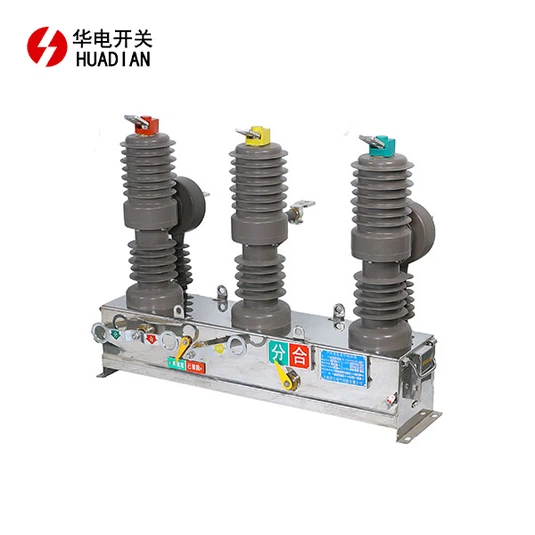
The overall structure of a porcelain-clad post-type outdoor vacuum circuit breaker is as follows: The upper porcelain bushing serves as the arc-extinguishing chamber bushing, containing a vacuum interrupter, and the lower porcelain bushing serves as the support bushing. Both the arc-extinguishing chamber bushing and the support bushing are filled with vacuum insulating grease with excellent insulating properties. During lightning activity, if the 35 kV line surge arrester is damaged or has poor lightning protection characteristics, overvoltage can intrude into the substation equipment along the line, causing a short circuit at weak points in the circuit breaker's insulation, resulting in equipment damage due to lightning strikes. The following preventive measures can be taken to address this.
I. Main Ways in Which Lightning Activity Affects Outdoor Vacuum Circuit Breakers
The impact of lightning on outdoor vacuum circuit breakers is not through a direct "strike" on the equipment itself, but mainly through the following two ways, which generate destructive overvoltages:
Direct Lightning Strike Overvoltage
Direct strike: Lightning directly strikes the circuit breaker body, the connected busbars, or the adjacent structures. This generates extremely high lightning currents and voltages, far exceeding the insulation withstand level of the equipment.
Consequences: This can lead to insulator flashover, explosion, external insulation breakdown of the vacuum interrupter, and even cause a three-phase short circuit, resulting in permanent damage to the equipment and power outage.
Induced Lightning Overvoltage (More Common)
Principle: When lightning strikes a line, pole, or the ground near the circuit breaker, it generates a strong transient electromagnetic field around it. This changing magnetic field induces extremely high overvoltages in the circuit formed by the circuit breaker, conductors, and structures.
Characteristics: Although the magnitude is usually lower than that of a direct lightning strike, it occurs more frequently and propagates along the line, posing a significant threat to the weak insulation points of the circuit breaker.
Lightning Surge Overvoltage
Principle: Even if lightning strikes a distant line, the lightning surge will propagate along the transmission line in the form of a traveling wave, reaching the circuit breaker at the substation. If the wave impedance is mismatched, refraction and reflection will occur, causing a voltage increase.
Affected Components: Mainly threatens the insulation between the circuit breaker contacts and the insulation to ground. Especially when the circuit breaker is in the open position, its contacts (between the moving and stationary contacts) need to withstand the full system phase voltage. The superposition of the lightning surge can easily lead to breakdown of the contacts, causing a "lightning strike breakdown" fault.
Ground Potential Rise
Principle: When lightning current is discharged into the ground through the grounding device, it generates extremely high instantaneous potential around the grounding body. If the grounding connections of different equipment within the substation (such as circuit breaker bases, control cabinets) are poor or there is a potential difference, it can lead to back-flashover overvoltage.
Impact: The high potential can "flash back" from the grounding wire to the equipment casing, and then intrude into the vulnerable secondary control system (such as the motor of the operating mechanism, opening and closing coils, and microprocessor protection devices), causing control failure or component burnout.
II. Specific Manifestations of Harm
Insulation Damage:
External Insulation: Surface flashover on porcelain or silicone rubber composite insulators leaves burn marks, reducing future insulation performance.
Internal Insulation: Although the vacuum interrupter is fully sealed, its external creepage distance may experience flashover due to contamination and superimposed lightning strikes. More importantly, the contact gap may be punctured under lightning overvoltage.
Mechanism Malfunction or Failure to Operate:
Induced overvoltage can intrude into the control module of the operating mechanism (such as spring mechanism, permanent magnet mechanism) through power lines or control cables, potentially causing the circuit breaker to trip unnecessarily (malfunction) or fail to operate during a fault (failure to operate), thus expanding the scope of the accident.
Secondary System Damage:
Electromagnetic pulses (LEMP) generated by lightning can couple to signal lines and power lines, damaging microprocessor-based protection and control devices, intelligent terminals (DTU/FTU), etc., leading to monitoring failure.
Accelerated Material Aging:
Frequent overvoltage surges accelerate the aging of insulating materials, shortening the service life of the equipment.
III. Comprehensive Protection Measures ("Three Lines of Defense")
For lightning protection of outdoor 35kV vacuum circuit breakers, a strategy of "comprehensive management and layered protection" must be adopted.
First Line of Defense: Interception and Discharge (Preventing direct strikes and reducing the amplitude of incoming surges)
Installation of lightning rods/lightning wires:
Install independent lightning rods or structural lightning rods in the substation (or the outdoor power distribution area where the circuit breaker is installed) to form an effective protection zone, ensuring that important equipment such as circuit breakers are within the protection umbrella against direct lightning strikes.
Reasonable placement of surge arresters:
A crucial measure! A gapless metal oxide arrester (MOA) must be installed at the power supply side entrance of the circuit breaker (usually installed in conjunction with a disconnect switch).
Installation location: It should be installed as close to the circuit breaker as possible to minimize the induced overvoltage on the connecting wires between them. Ideally, the electrical distance between the surge arrester and the circuit breaker should not exceed the specified value (such as the "electrical distance" requirement in the regulations).
Function: When the lightning overvoltage reaches the operating voltage of the surge arrester, the arrester quickly conducts, limiting the overvoltage to a safe level that the circuit breaker's insulation can withstand, and discharging the lightning current to the ground.
Second Line of Defense: Equipotential Bonding and Grounding (Providing a reliable discharge path and equalizing potential)
Improved Grounding System:
The grounding grid of substations and circuit breaker bodies must comply with regulations, ensuring sufficiently low grounding resistance (usually required to be ≤0.5Ω). Low-resistance grounding can quickly discharge lightning current and reduce the magnitude of ground potential rise.
The circuit breaker base, operating mechanism box, and metal framework should have at least two reliable grounding points.
Equipotential Bonding:
Metal components near the circuit breaker (such as supports, cable conduits, and cable trays) and control box enclosures should be well-connected to the main grounding grid to prevent backflash caused by potential differences.
Third Line of Defense: Shielding and Isolation (Protecting the Secondary System)
Shielding and Wiring:
All control cables and signal cables leading to the circuit breaker operating mechanism and control box should be armored or routed through metal conduits, and both ends of the metal armor or metal conduit must be reliably grounded.
Shielded cables should be used preferentially, and the shielding layer must also be grounded at both ends.
Installation of Surge Protective Devices (SPDs):
SPDs of the appropriate voltage level (e.g., DC220V/AC220V power supply SPD, signal SPD) must be installed at the circuit breaker operating power input and control signal circuit input.
SPDs can effectively suppress lightning surges entering from the lines, protecting secondary electronic equipment. A multi-stage coordinated SPD protection system should be established.
Isolation Measures:
For important signal circuits, optocouplers or signal isolation transformers can be used for electrical isolation to cut off the conduction path of lightning overvoltage.
IV. Operation and Maintenance Suggestions
Regular Preventive Testing:
Perform DC reference voltage (U1mA) and leakage current tests on surge arresters according to regulations to ensure their proper functioning.
Conduct insulation resistance and AC withstand voltage tests on circuit breakers, especially checking the power frequency and impulse withstand voltage levels of their contacts.
Grounding Grid Inspection:
Regularly test the grounding resistance and check for corrosion or breakage of grounding down conductors.
Condition Monitoring:
Before and after the thunderstorm season, strengthen inspections to check for flashover traces on insulator surfaces, ensure the mechanism box is properly sealed, and verify that the SPD status indicator is functioning correctly.
Monitor Operating Status:
For circuit breakers on lines in the open/standby state, their lightning protection (mainly the busbar side surge arresters) must remain continuously engaged.
Summary
Lightning strikes pose a systemic threat to 35kV outdoor vacuum circuit breakers, affecting both the primary insulation and the secondary control system. The most crucial and effective preventive measure is to "install high-performance metal oxide arresters (MOAs) in close proximity to the circuit breaker," supplemented by reliable grounding, comprehensive surge protection for the secondary system, and standardized operation and maintenance. Only by building a multi-layered protection system from air to ground and from primary to secondary systems can the safe and stable operation of vacuum circuit breakers under lightning conditions be maximized.
Shaanxi Huadian 35kV outdoor vacuum circuit breakers, with their innovative technology, define a new standard for outdoor switches. They feature a high-strength, weather-resistant composite insulation casing, significantly increasing creepage distance. Combined with an optimized electric field design, they effectively prevent surface flashover even under extreme conditions of lightning overvoltage and pollution, ensuring excellent and long-lasting insulation performance. Equipped with a fully sealed, modular spring or permanent magnet operating mechanism, they boast a mechanical life of over 10,000 operations. A built-in anti-condensation device ensures the mechanism box remains dry. For inquiries, please contact us:pannie@hdswitchgear.com.


