Electromagnetic interference (EMI) is a significant concern in the operation of electrical equipment, especially for high - voltage vacuum circuit breakers like the ZN85 - 40.5 Vacuum Circuit Breaker. As a supplier of the ZN85 - 40.5 Vacuum Circuit Breaker, I understand the importance of reducing EMI to ensure the reliable and safe operation of the equipment. In this blog, I will share some effective methods to reduce the electromagnetic interference of the ZN85 - 40.5 Vacuum Circuit Breaker.
Understanding Electromagnetic Interference in ZN85 - 40.5 Vacuum Circuit Breaker
Before discussing the reduction methods, it is essential to understand the sources of electromagnetic interference in the ZN85 - 40.5 Vacuum Circuit Breaker. The main sources of EMI in this type of circuit breaker include:
- Arc quenching process: When the circuit breaker interrupts the current, an arc is formed in the vacuum interrupter. The rapid change of current and voltage during the arc quenching process generates strong electromagnetic fields, which can radiate electromagnetic interference.
- Switching operations: The mechanical switching actions of the circuit breaker, such as closing and opening, can cause sudden changes in the electrical circuit, leading to the generation of electromagnetic transients.
- External electromagnetic environment: The ZN85 - 40.5 Vacuum Circuit Breaker may be affected by external electromagnetic fields from other electrical equipment in the substation or power grid, such as transformers, reactors, and transmission lines.
Methods to Reduce Electromagnetic Interference
1. Shielding Design
Shielding is one of the most effective ways to reduce electromagnetic interference. For the ZN85 - 40.5 Vacuum Circuit Breaker, we can use the following shielding measures:
- Metal enclosure: The circuit breaker should be enclosed in a well - grounded metal cabinet. The metal enclosure acts as a Faraday cage, which can effectively block the radiation of electromagnetic fields. The metal should have good conductivity, and the enclosure should be continuous without any large gaps or holes to ensure the shielding effectiveness.
- Shielding for internal components: Inside the circuit breaker, sensitive components such as control circuits and sensors can be individually shielded. For example, using shielded cables for signal transmission can reduce the interference from external electromagnetic fields.
2. Filtering
Filtering is another important method to reduce electromagnetic interference. By installing filters in the power supply and signal circuits of the circuit breaker, we can suppress the high - frequency interference signals.
- Power supply filter: A power supply filter can be installed at the input of the circuit breaker's control power supply. The filter can block the high - frequency noise from the power grid and prevent it from entering the circuit breaker's internal circuits.
- Signal filter: For the signal circuits, such as the control signals and monitoring signals, signal filters can be used to remove the interference signals. These filters can be designed according to the frequency characteristics of the interference signals.
3. Grounding
Proper grounding is crucial for reducing electromagnetic interference. A good grounding system can provide a low - impedance path for the interference currents, so that the interference energy can be effectively dissipated to the ground.
- Main grounding: The metal enclosure of the circuit breaker should be firmly connected to the main grounding grid of the substation. The grounding resistance should be as low as possible, usually less than 4 ohms.
- Separate grounding for sensitive components: Sensitive components inside the circuit breaker, such as control circuits and communication circuits, can have their own separate grounding points. This can prevent the interference currents from flowing through the sensitive circuits and causing interference.
4. Circuit layout optimization
The layout of the internal circuits of the circuit breaker can also affect the electromagnetic interference. By optimizing the circuit layout, we can reduce the coupling between different circuits and the radiation of electromagnetic fields.
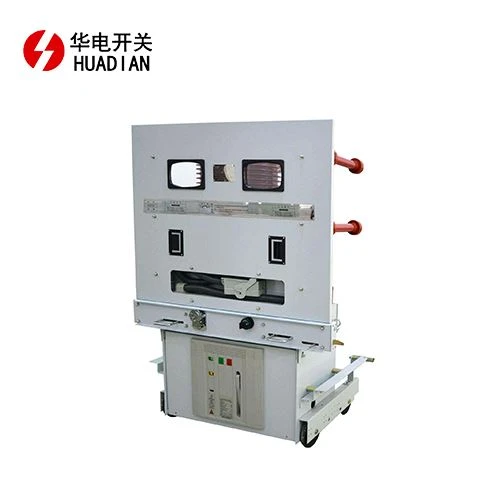

- Separation of power and signal circuits: The power circuits and signal circuits should be separated as much as possible to reduce the electromagnetic coupling between them. For example, the power cables and signal cables should be routed in different cable trays or conduits.
- Minimizing loop area: In the circuit design, the loop area of the electrical circuits should be minimized. A large loop area can act as an antenna, radiating electromagnetic fields. By reducing the loop area, we can reduce the radiation of electromagnetic interference.
5. Arc control
Since the arc quenching process is a major source of electromagnetic interference, controlling the arc can effectively reduce the EMI.
- Improving arc - quenching performance: By improving the design of the vacuum interrupter, such as optimizing the contact material and shape, we can enhance the arc - quenching performance of the circuit breaker. A faster and more stable arc quenching process can reduce the duration and intensity of the electromagnetic fields generated during the arc quenching process.
- Using arc - suppression devices: Arc - suppression devices, such as surge arresters and snubbers, can be installed in the circuit to suppress the over - voltage and current transients caused by the arc quenching process.
Comparison with Other Similar Circuit Breakers
When considering the electromagnetic interference reduction of the ZN85 - 40.5 Vacuum Circuit Breaker, it is also interesting to compare it with other similar circuit breakers, such as the 33kv Vacuum Circuit Breaker, ZN12 - 40.5 Vacuum Circuit Breaker, and ZN39 - 40.5 Vacuum Circuit Breaker.
Each type of circuit breaker has its own characteristics in terms of electromagnetic interference. The ZN85 - 40.5 Vacuum Circuit Breaker may have different arc - quenching mechanisms and internal structures compared to the other models. However, the basic principles of reducing electromagnetic interference, such as shielding, filtering, grounding, and circuit layout optimization, are applicable to all these circuit breakers.
Conclusion
Reducing the electromagnetic interference of the ZN85 - 40.5 Vacuum Circuit Breaker is a complex but necessary task. By using a combination of shielding, filtering, grounding, circuit layout optimization, and arc control methods, we can effectively reduce the electromagnetic interference and ensure the reliable and stable operation of the circuit breaker.
If you are interested in our ZN85 - 40.5 Vacuum Circuit Breaker or have any questions about reducing electromagnetic interference, please feel free to contact us for further discussion and procurement negotiation.
References
- "Electromagnetic Compatibility Engineering" by Henry W. Ott.
- "High - Voltage Circuit Breakers: Theory and Practice" by M. S. Sachdev.
- Standards related to electromagnetic compatibility of electrical equipment, such as IEC 61000 series.