


Sulfur Hexafluoride Circuit Breaker
Your Leading Shaanxi huadian electric co., Ltd. Supplier
Shaanxi huadian electric co., Ltd. It is located in Baoji high-tech development zone, Shaanxi province. A modern high-tech enterprise specializing in integrating research and development, manufacturing, and sales of vacuum circuit breakers.
Shaanxi huadian has nearly 10,000 square meters of circuit breaker production workshop, and has a fully automated control assembly line and a full set of imported circuit breaker testing equipment, with an annual production capacity of 10,000 units.
Why Choose Us?
High Quality
Our products every tiny part is made of the most suitable material,every single product comes out with strict inspection.
Advanced Equipment
Our has a fully automated control assembly line and a full set of imported circuit breaker testing equipment.
Good Service
We have complete pre-sales and after-sales service, professional team, 24 hours to serve you.
Technical Support
We has a professional research, and development team and a new product laboratory.


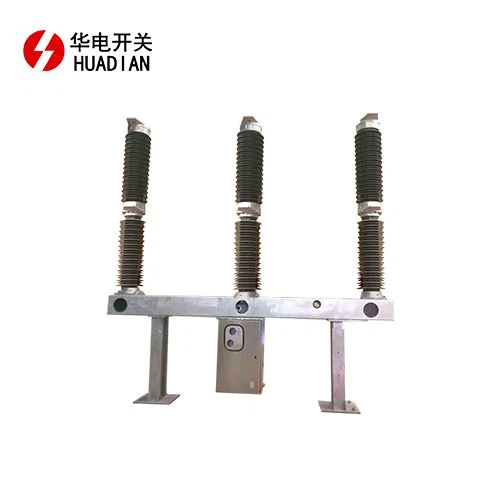
Sulfur hexafluoride circuit breakers protect electrical power stations and distribution systems by interrupting electric currents, when tripped by a protective relay. Instead of oil, air, or a vacuum, a sulfur hexafluoride circuit breaker uses sulfur hexafluoride (SF6) gas to cool and quench the arc on opening a circuit. Advantages over other media include lower operating noise and no emission of hot gases, and relatively low maintenance. Developed in the 1950s and onward, SF6 circuit breakers are widely used in electrical grids at transmission voltages up to 800 kV, as generator circuit breakers, and in distribution systems at voltages up to 35 kV.
Sulfur hexafluoride circuit breakers may be used as self-contained apparatus in outdoor air-insulated substations or may be incorporated into gas-insulated switchgear which allows compact installations at high voltages.
Benefits of Sulfur Hexafluoride Circuit Breaker
SF6 gas has excellent insulating, arc extinguishing and many other properties which are the greatest advantages of SF6 circuit breakers.
The gas is non-inflammable and chemically stable. Their decomposition products are non-explosive and hence there is no risk of fire or explosion.
Electric clearance is very much reduced because of the high dielectric strength of SF6.
Its performance is not affected due to variations in atmospheric condition.
It gives noiseless operation, and there is no over voltage problem because the arc is extinguished at natural current zero.
There is no reduction in dielectric strength because no carbon particles are formed during arcing.
It requires less maintenance and no costly compressed air system is required.
SF6 performs various duties like clearing short-line faults, switching, opening unloaded transmission lines, and transformer reactor, etc. without any problem.
Types of Sulfur Hexafluoride Circuit Breaker
01
Non-puffer Sf6 Circuit Breaker
A non-puffer type SF6 circuit breaker is a type of high-voltage electrical circuit breaker used in power transmission and distribution systems to protect electrical equipment from short circuits and overloads. the reason this is called non-puffer because it does not depend on high-pressure gas blast to extinguish the electric arc during interruption.
02
Single Pressure Sf6 Circuit Breaker
In the SF6 circuit breaker the SF6 gas is stored at a high pressure around 20 BA in a pressure vessel. The contacts are opened and closed by the movement of the operating rod.
03
Double Pressure Sf6 Circuit Breaker
In Double pressure SF6 circuit breakers the gas is stored at two different pressure levels: high pressure (around 20 bar) and low pressure (around 3-4 bar). This design provides better control over the release of SF6 gas during circuit breaker operation.
Application of Sulfur Hexafluoride Circuit Breaker
Power Transmission And Distribution
SF6 circuit breakers are widely used in power transmission and distribution systems. They are commonly found in substations, where they play a crucial role in ensuring the safe and efficient operation of the electrical grid. The ability of SF6 circuit breakers to handle high voltages and interrupt large fault currents makes them ideal for this application.
Industrial Applications
In industrial settings, SF6 circuit breakers are used to protect heavy machinery and equipment. Industries such as manufacturing, mining, and petrochemicals rely on SF6 circuit breakers to ensure the safety and reliability of their electrical systems. The low maintenance requirements and high performance of SF6 circuit breakers make them a preferred choice in these demanding environments.
Renewable Energy Systems
As the adoption of renewable energy sources such as wind and solar power increases, the need for reliable and efficient circuit breakers becomes more critical. SF6 circuit breakers are used in renewable energy systems to protect the electrical infrastructure and ensure the stable operation of the grid. Their ability to handle high voltages and interrupt fault currents makes them suitable for integrating renewable energy sources into the existing electrical network.
Railways
SF6 circuit breakers are used in railway electrification systems to ensure reliable power distribution.
Substations
SF6 circuit breakers are employed in substations to control and protect the electrical grid.
Power Generation
SF6 circuit breakers can be used in power generation facilities for generator protection.
Fixed Contact: The fixed contact is a stationary component of the circuit breaker that remains in place throughout operation. It is often made of a high conductivity material, such as copper or silver, and is intended to provide a reliable connection point for electrical current.
Moving Contact: The moveable contact is a component of the circuit breaker that may be moved to create or break an electrical circuit. It is frequently linked to a mechanism that enables it to move in response to command signals. The moving contact is intended to maintain consistent contact with the fixed contact throughout operation.
Insulated Nozzle: The insulated nozzle is a component that surrounds the fixed contact and directs the flow of SF6 gas during operation. It is intended to offer insulation while preventing SF6 gas leaking from the circuit breaker.
Valve: The valve regulates the amount of SF6 gas that enters and exits the circuit breaker. To keep the SF6 gas inside the circuit breaker at the proper pressure and flow rate, it is usually operated manually or automatically.
SF6 gas
The insulating and extinguishing medium found in SF6 circuit breakers is called SF6 gas. It is a good electrical insulator that is colorless, odorless, nontoxic, and nonflammable. In order to extinguish arcs, SF6 gas is discharged into the arc chamber during operation from sealed receptacles inside the circuit breaker.
Fixed piston
During operation, the circuit breaker’s fixed piston, a stationary component, aids in compressing and storing SF6 gas. Its purpose is to keep the SF6 gas pressure inside the circuit breaker at the appropriate level.
Movable cylinder
SF6 gas is compressed during operation by the moving contact, which is housed in the movable cylinder. It responds to control signals by moving and aids in building up the pressure required to put out arcs inside the circuit breaker.

Regular Inspection And Monitoring
Regular inspection and monitoring are crucial to ensure the operational integrity of SF6 circuit breakers. This includes checking for gas leaks, monitoring gas pressure, and inspecting the mechanical and electrical components of the breaker. Advanced monitoring systems can provide real-time data on the condition of the breakers, facilitating proactive maintenance and reducing the risk of unexpected failures.
Gas Handling And Leakage Prevention
Proper gas handling techniques are essential to prevent leakage and ensure the efficient operation of SF6 circuit breakers. This involves using specialized tools and equipment for gas filling, recovery, and recycling. Leakage prevention also relies on regular checks of gas seals and fittings, with prompt repair or replacement of any defective parts.
Working Principle of SF6 Circuit Breaker
The SF6 gas is compressed and stored inside a tank. During the fault conditions, the contacts are separated and an arc is struck between them. The highly pressurized SF6 gas is also released at the same moment.
The arc which is the movement of charges contains free electrons. The SF6 being highly electronegative, absorbs the free electrons forming negative ions. These ions are heavier and have low mobility as compared to free electrons.
SF6 + e– = SF6–
SF6 + e– = SF5– + F
Due to the heavy mass of the formed negative ions, the movement of the charges reduces between the contacts. This increases the dielectric strength of the medium that quenches the arc at zero current. The blast of SF6 gas also reduces the temperature of the arc which also reduces its strength. The pressure of the gas is also directly proportional to the dielectric strength of the SF6 gas.
Gas Handling Recommendations for SF6 Circuit Breakers
During routine maintenance of an SF6 gas circuit breaker or in the event of a failure, the gas insulated equipment may need to be opened. This requires SF6 gas handling to remove as much gas as possible and place the breaker into the vacuum to avoid SF6 emissions. In its pure form, SF6 gas is inert and non-toxic; however, dangerous SF6 by-products form when the gas is exposed to a fault. By-products such as SO2 can also form when SF6 circuit breakers are in service for a long time and exposed to high heat and moisture.
We always recommend checking the quality of SF6 gas with an analyzer before beginning any handling procedures as by-products of SF6 are extremely hazardous to human health. In addition, by-products will damage gas handling equipment and accessories. Special PPE must be worn, and best-practices must be followed to ensure the safety of technicians. You can learn more by watching our free webinar: Emergent By-Product Cleanup Services.
In addition to being aware of the gas quality and knowing how to handle SF6 by-products correctly, users must also take great care to avoid producing any SF6 emissions. SF6 gas has the highest Global Warming Potential of any gas known to man. Ideally, SF6 should be handled in a closed-loop system. Proper training and emission-free SF6 gas handling equipment is very important to prevent emissions.
Design Requirements
In addition to the general characteristics normally associated with an electrical switch i.e. low contact resistance when closed and almost perfect insulation in open condition, a high voltage SF6 circuit breaker needs to fulfil additional design requirements. Amongst these, the most pertinent ones are briefly described below:
Rated current – The current carrying parts of the circuit breaker should be able to carry the maximum anticipated load current without exceeding temperature rise
Rated short circuit breaking current – The circuit breaker should have the ability to interrupt the maximum short circuit current of the network (typical standardized values are 25, 40 and 63 kA).
Rated voltage and insulation level – The insulation of the circuit breaker externally, and across the contacts, should be able to withstand specified magnitudes of low frequency and transient overvoltages.
Re-strikes – During capacitive current breaking, the probability of re-strike (re-ignition) between circuit breaker contacts should be very low.
Mechanical endurance – The circuit breaker should be able to undergo a large number of operations (2,000 to 10,000) with very limited maintenance.
Opening time – To achieve adequate clearance between contacts and in order to withstand TRV, a circuit breaker needs to open an extremely fast speed (in the order of 40 to 60 ms).
Rated operating sequence – The circuit breaker is required to satisfactory complete a specified operating sequence. For high speed reclosing circuit breakers, a typical sequence is: O-0.3sec-CO-3min-CO (where O and C represent opening and closing respectively, and 0.3sec and 3min are time delays).
Switching duty – During the course of its service life, the circuit breaker should be able to successfully undertake a variety of switching (interruption) duties that most notably include: terminal and short line faults, transformer and reactor switching, and capacitive current interruption. In terms of demands on the circuit breaker, these different types of switching duties vary the magnitude of current and TRV that a circuit breaker is required to withstand.
How To Use SF6 Circuit Breakers?
The operation of the SF6 circuit breaker is divided into two types:
One is the opening operation; the other is the closing operation.
Check that the SF6 gas pressure is normal (0.5MPa), and do not operate when it is lower than 0.4MPa.
Turn on the control power supply of the circuit breaker, switch on the power supply, and set the "remote control-near control" switch to the "remote control" position.
When the sf6 circuit breaker is opened and closed with a microcomputer, there should be a corresponding displacement signal on the main wiring diagram.
In case of emergency, sf6 circuit breaker can be opened and closed by the control switch in the main control room main transformer protection screen.
When the sf6 electric circuit breaker cannot be opened, the operating mechanism of the circuit breaker can be manually opened, and the circuit breaker can be opened for inspection after disconnection.
The gas pressure of the SF6 circuit breaker should be kept at 0.5MPa. When it is lower than 0.4MPa, the operating power of the circuit breaker should be disconnected in time, and it is forbidden to operate the circuit breaker with load. Report to the workshop immediately and arrange maintenance personnel to supply air to the circuit breaker.
What Is the Air Pressure to Be Maintained in Sf6 Breakers?
Sulfur hexafluoride (SF6) circuit breakers are high-voltage electrical switches that use SF6 gas as the medium for arc extinction. The pressure of SF6 gas in the circuit breaker is an important parameter that needs to be maintained within certain limits for the proper functioning of the breaker. The typical pressure range for SF6 gas in circuit breakers is around 0.5 to 0.7 MPa (5 to 7 bar or 72.5 to 101.5 psi).
It is crucial to maintain the proper SF6 gas pressure in the circuit breaker to ensure effective arc extinguishing performance and insulation properties. Deviations from the recommended pressure range can affect the breaker's operation and may lead to malfunction or failure. Regular monitoring and maintenance of the SF6 gas pressure are essential to ensure the reliable and safe operation of SF6 circuit breakers.
Our Factory
Shaanxi huadian electric co., Ltd. It is located in Baoji high-tech development zone, Shaanxi province. A modern high-tech enterprise specializing in integrating research and development, manufacturing, and sales of vacuum circuit breakers.
