Below, I will explain in detail from four aspects: definition, structural comparison, advantages and disadvantages, and application scenarios.
I. Core Definitions
Fixed Type: The circuit breaker body is directly and permanently fixed to the frame or busbar of the complete switchgear (such as the fixed cabinet in the KYN28A cabinet) using bolts. When inspection or maintenance is required, power must be disconnected and personnel must enter the cabinet to perform the operation.
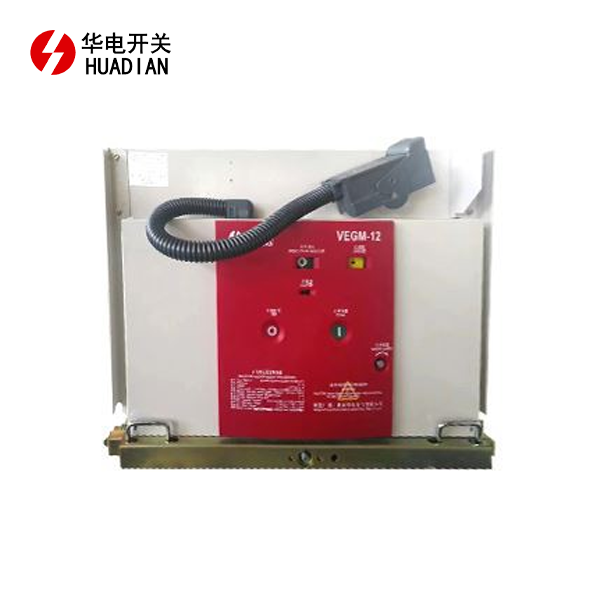
Withdrawable Type: The circuit breaker body is mounted on a movable drawer (chassis). This drawer acts like a "drawer," which can be pushed in (working position) or pulled out (test/isolation position) along the guide rails inside the cabinet using a lever or manually, or even completely removed from the cabinet.
II. Comparison of Key Differences
| Features | Fixed vacuum circuit breaker | Handcart-type vacuum circuit breaker |
|---|---|---|
| Installation Method | It is fixed with bolts and cannot be moved. | Installed on a portable handcart, it can be pushed in and pulled out. |
| Inspection and Maintenance | It needs to be done inside a cabinet, which may limit space and make the operation inconvenient. | The handcart can be pulled to the "test position" or completely pulled out of the cabinet to conduct the test in a spacious area outside the cabinet, which is safe and convenient. |
| Power Outage Time | During maintenance, the relevant circuits and busbars need to be shut down for an extended period of time. | It can quickly replace the spare handcart, greatly shortening the fault recovery time. |
| Isolation and Visibility | Although the circuit breaker is disconnected, its stationary contacts are still energized and lack obvious physical isolation points, posing a safety hazard. | After being pulled to the test/isolation position or removed, the separation distance between the moving and stationary contacts is visible to the naked eye, forming a clear physical break point, ensuring high safety. |
| Interlocking and Safety | The interlocking mechanism is relatively simple. | It has complete mechanical interlocking (such as "five-proof" functions) to prevent misoperation (such as pulling a handcart under load). |
| Structural Complexity | Simple, few parts. | It is more complex, with the addition of handcarts, guide rails, primary moving/stationary contacts, secondary plug-ins, positioning and interlocking devices, etc. |
| Cost | Lower cost (both the equipment itself and the cabinet are cheaper). | Higher cost (circuit breakers and switchgear have complex structures and high manufacturing costs). |
| Footage | Usually smaller (due to simpler structure). | Typically larger (space needs to be reserved for the movement and withdrawal of the handcart). |
III. Summary of Advantages and Disadvantages
Advantages of Cart-Type (Removable) Circuit Breaker:
High Power Supply Reliability:In case of failure, a backup cart can be quickly used for replacement, achieving "hot standby" and greatly reducing power outage time.
Safe and Convenient Maintenance:The circuit breaker can be moved outside the cabinet for maintenance, safely isolated from live parts, and provides ample working space.
Clear Isolation:A clearly visible physical disconnect point conforms to safe operating procedures, providing a strong sense of psychological security.
Good Flexibility:Facilitates testing, debugging, and regular maintenance.
Disadvantages of Cart-Type (Removable) Circuit Breaker:
High Cost:Higher equipment purchase and subsequent maintenance costs.
Complex Structure, Potential Failure Points:The cart track, contact alignment, and secondary connectors can all become potential failure points, requiring high manufacturing and installation precision.
Large Space Occupancy:The cabinet size is typically larger than that of a fixed circuit breaker.
High Operational Requirements:Requires standardized operation to prevent damage to the equipment due to inaccurate contact alignment or improper handling.
Advantages of fixed-type systems:
Economical: Low initial investment and maintenance costs.
Simple and reliable structure: Fewer components, robust connections, and fewer potential mechanical failure points.
Small footprint: Suitable for spaces with limited space.
Stable conductive circuit performance: Fixed connections ensure more stable contact resistance, less prone to deterioration from repeated plugging and unplugging.
Disadvantages of fixed-type systems:
Poor power supply continuity: The circuit must be de-energized for extended periods during maintenance.
Inconvenient and unsafe maintenance: Personnel must enter the vicinity of the energized cabinet (even after power is off, complex safety measures such as voltage testing and grounding are still required), resulting in a cramped working space.
Lack of visible isolation points: Weaker psychological safety awareness.
IV. Application Scenarios
Priority Selection for Handcart-Type (Withdrawn) Circuit Breakers:
Scenarios with high power supply continuity requirements:Such as data centers, hospitals, large production lines, chemical plants, metallurgical plants, and other primary or critical loads.
Circuit systems requiring frequent operation, maintenance, or testing.
Power distribution systems with complex structures requiring rapid replacement of backup circuit breakers.
Locations with strict safety regulations requiring clear physical isolation points.
Priority Selection for Fixed Circuit Breakers:
Cost-sensitive projects:Such as terminal power distribution in small factories, residential communities, and commercial buildings.
End or branch lines of circuits with relatively low power supply reliability requirements.
Power distribution rooms with very limited space.
Scenarios with stable operating environments and no need for frequent operation and maintenance.
Fixed installation is also commonly used in some ring main units (such as SF6 ring main units) because they are designed for line segmentation and have low operation frequency.
Summary and Recommendations
The choice between stationary and mobile switchgear is essentially a trade-off between economy, reliability, and convenience.
In medium- and high-voltage (e.g., 10kV, 35kV) main distribution systems and critical circuits, mobile switchgear is almost the standard choice to improve power supply reliability and operational safety.
In low-voltage systems or non-critical terminal circuits of high-voltage systems, stationary switchgear is a more economical and practical choice to save costs and space.
In actual design and selection, a comprehensive decision needs to be made based on the user's power load level, budget, substation conditions, and operational capabilities. In modern large-scale projects, a mixed approach is often used: mobile switchgear is used for incoming and important outgoing lines, while stationary switchgear is used for some secondary outgoing lines.
Shaanxi Huadian Vacuum Circuit Breakers focuses on the research and development of vacuum arc-extinguishing technology and intelligent electrical control, providing highly reliable, all-scenario circuit breaker solutions for power grids and enterprises. Contact information:pannie@hdswitchgear.com.