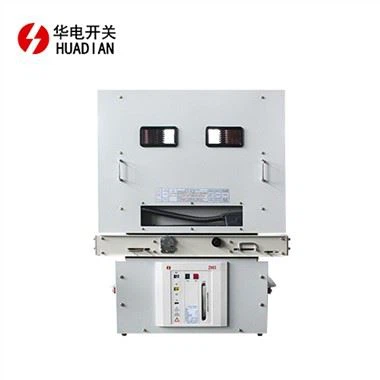
As a supplier of the ZN85 - 40.5 Fuse Handcart, I've witnessed firsthand the intricate relationship between contact resistance and the performance of this essential electrical equipment. In this blog, I'll delve into how contact resistance impacts the ZN85 - 40.5 Fuse Handcart and why it's crucial for both manufacturers and end - users to understand this dynamic.
Understanding Contact Resistance in Electrical Equipment
Contact resistance is the resistance encountered at the interface between two conductors in contact. In the case of the ZN85 - 40.5 Fuse Handcart, these contacts are vital for the proper flow of electrical current. When current passes through a contact point, the contact resistance can cause several effects.
The contact resistance is influenced by multiple factors. Surface conditions play a significant role. If the contact surfaces are dirty, corroded, or have unevenness, the contact area is reduced, leading to an increase in contact resistance. For example, in a high - humidity environment, oxidation can occur on the contact surfaces of the ZN85 - 40.5 Fuse Handcart, forming a thin layer of oxide that acts as an insulator and raises the resistance.
The force applied at the contact also affects the resistance. Insufficient contact force can result in a larger contact resistance because the effective contact area is decreased. In the ZN85 - 40.5 Fuse Handcart, proper installation and maintenance are required to ensure that the contact force meets the design specifications.
Impact on Electrical Performance
One of the most immediate impacts of high contact resistance is power loss. According to Joule's law, the power dissipated at a resistance is given by (P = I^{2}R), where (I) is the current and (R) is the resistance. In the ZN85 - 40.5 Fuse Handcart, if the contact resistance is high, more power will be dissipated as heat at the contact points. This not only wastes energy but can also lead to overheating.
Overheating is a serious concern as it can damage the components of the ZN85 - 40.5 Fuse Handcart. The excessive heat can cause the insulation materials to degrade, reducing their dielectric strength. This, in turn, increases the risk of electrical breakdown and short - circuits. For instance, if the insulation around the contacts of the fuse handcart is damaged due to overheating, it can lead to a direct short between the conductors, potentially causing a major electrical failure.
High contact resistance can also affect the accuracy of the fuse operation. The ZN85 - 40.5 Fuse Handcart is designed to protect the electrical system by interrupting the current when a fault occurs. However, if the contact resistance is too high, the voltage drop across the contacts can be significant. This may cause the fuse to operate at a lower current than its rated value, leading to false tripping. On the other hand, in some cases, the high resistance may prevent the fuse from operating properly when a real fault occurs, as the current may not reach the level required to blow the fuse.
Impact on Mechanical Performance
Contact resistance can also have an impact on the mechanical performance of the ZN85 - 40.5 Fuse Handcart. The heat generated due to high contact resistance can cause thermal expansion of the contact materials. This expansion can lead to mechanical stress on the contacts and other components of the handcart. Over time, this stress can cause the contacts to deform, further increasing the contact resistance in a vicious cycle.
The mechanical movement of the ZN85 - 40.5 Fuse Handcart is also affected. If the contacts are overheated and deformed, the smooth operation of the handcart may be hindered. For example, the insertion and withdrawal of the handcart into the switchgear may become difficult, which can cause delays in maintenance and repair operations.
Mitigating the Effects of Contact Resistance
To ensure the optimal performance of the ZN85 - 40.5 Fuse Handcart, it's essential to take measures to reduce contact resistance. Regular maintenance is key. This includes cleaning the contact surfaces to remove dirt, dust, and oxidation. Special cleaning agents can be used to effectively clean the contacts without damaging them.
Proper installation is also crucial. Ensuring that the contact force is within the specified range can significantly reduce contact resistance. During installation, technicians should use appropriate tools to measure and adjust the contact force.
In addition, using high - quality contact materials can help reduce contact resistance. Materials with good electrical conductivity and corrosion resistance, such as copper alloys, are often used in the ZN85 - 40.5 Fuse Handcart. These materials can maintain low contact resistance over a long period.


Conclusion and Call to Action
Contact resistance has a profound impact on the performance of the ZN85 - 40.5 Fuse Handcart. It affects both the electrical and mechanical aspects of the equipment, and if not properly managed, can lead to serious operational problems.
As a supplier of the ZN85 - 40.5 Fuse Handcart, we are committed to providing high - quality products and professional technical support. Our products, such as the ZN85 - 40.5 Fuse Handcart, ZN85 - 40.5 Porential Transformer Handcart, and ZN85 - 40.5 Insulator Handcart, are designed to minimize contact resistance and ensure reliable performance.
If you are in need of high - quality electrical equipment or have any questions about the ZN85 - 40.5 Fuse Handcart, we welcome you to contact us for further discussion and potential procurement. Our team of experts is ready to assist you in finding the best solutions for your electrical needs.
References
- "Electrical Contacts: Principles and Applications" by E. M. Trimmer.
- "High - Voltage Switchgear Handbook" by various authors.
- Technical specifications of ZN85 - 40.5 Fuse Handcart provided by relevant industry standards.