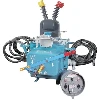
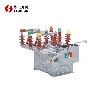
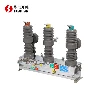
Ring Main Unit (RMU) is a key equipment used in medium voltage distribution network (usually 10kV or 20kV), which is mainly used to realise the ring power supply, fault isolation and load distribution of electricity. Its core function is to improve the reliability of power supply and ensure that the grid can switch paths quickly in case of faults to avoid large-scale power outages. The following is the detailed operation principle and workflow of ring network cabinet:

1. Basic structure of ring main unit
◆Ring main unit usually consists of the following modules:
◆Incoming unit: connects to the upper power supply (such as substation or trunk line).
◆Outgoing unit: connects to the lower load (such as transformer, branch line).
◆Busbar: conductive channel connecting incoming and outgoing lines.
◆Switchgear:
Load switch: load-connecting circuit, but cannot cut off short-circuit current.
Circuit breaker (optional): can cut off short-circuit current for protection.
Isolating switch: isolates the circuit during maintenance, without arc extinguishing capability.
◆Protective device: such as fuse (protection transformer), relay protection unit, etc.
◆Insulating medium: gas (SF₆), solid (epoxy resin) or air insulation.
2. Basic principle of ring power supply
The core of the ring network cabinet is to construct a closed ring power grid to achieve redundancy and backup by supplying power through multiple power sources or multiple paths. Its operation process is as follows:
(1) Normal power supply mode
Power enters the ring network cabinet from two or more directions (e.g., A inlet and B inlet), but usually only the main inlet (e.g., A) is supplied, with the standby inlet (B) on hot standby.
The outlet unit distributes the power to transformers or subordinate lines, forming a ring network (figure below):
Substation A → RING 1 → RING 2 → RING 3 → Substation B
The load switches in the ring main unit remain closed to ensure that power flows along the ring path.
(2) Fault isolation and switching
When a section of the line fails (such as a cable short circuit between ring main units 2 and 3):
Fault detection: The protection device (such as relay protection or fuse) detects an overcurrent or short circuit signal.
Disconnect the fault section:
The load switches of ring main units 2 and 3 automatically or manually trip to isolate the fault area.
Backup path power supply:
The power supply is reversed from substation B through ring main unit 3 to restore the load power supply downstream of ring main unit 2.
At this time, the power grid becomes:
Substation A → Ring main unit 1 → Ring main unit 2 (fault section isolation)
Substation B → Ring main unit 3 → Downstream load of ring main unit 2
(3) Overhaul and maintenance
Disconnecting the circuit by isolation switch ensures the safety of maintenance personnel.
Solid or gas-insulated ring mains cabinets can reduce the scope of power outages and realise 'non-stop maintenance'.
3. Key operating functions
| Function | Implementation |
| Ring network power supply | A closed loop is formed through multi-incoming line design and load switch switching. |
| Fault isolation | The load switch or circuit breaker trips, and the fault section is quickly cut off in conjunction with the protection device (fuse, relay). |
| Load transfer | Manually or automatically switch the incoming line path (such as switching from A incoming line to B incoming line). |
| Transformer protection | The high-voltage side adopts a "load switch + fuse" combination. When a short circuit occurs, the fuse blows to protect the distribution transformer. |
4. Typical wiring schemes
Common wiring schemes for ring network cabinets include:
Single ring network: a ring main line, suitable for general urban power distribution.
Substation A → RMU1 → RMU2 → RMU3 → Substation B
Dual-ring network: Two independent ring networks, used for high reliability requirements (such as data centers).
Radial: The ring main unit acts as a branch node, radiating power supply in multiple directions.
5.Ring main unit and ordinary switch cabinet
| Comparison Items | Ring main unit | ordinary switch cabinet |
| Design purpose | ring network power supply, fault isolation | single line power distribution and control |
| Structural complexity | Multiple input and output lines, modular design | Simple structure, single function |
| Power supply reliability | High (supports redundant paths) | Low (no backup paths) |
6.Conclusion
The ring main unit achieves the following through ring network design and flexible switch configuration:
◆High power supply reliability: fast isolation and path switching in case of fault.
◆Flexible expansion: modular design facilitates capacity expansion or transformation.
◆Adapt to complex environments: gas or solid insulation technology ensures stable outdoor/indoor operation.
The core of its operation is "closed-loop design, open-loop operation", which not only retains the redundancy of ring power supply but also avoids circulation problems. It is an indispensable device for modern distribution networks.
Would you like help with a specific inquiry ? Let me know so I can guide you further! Email:pannie@hdswitchgear.com.