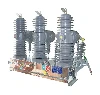
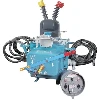
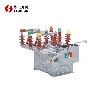
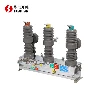
In the design of low-voltage power distribution systems and switch cabinet manufacturing, the circuit breaker phase spacing (pole spacing) is often regarded as an "installation size" parameter. In fact, it is one of the key boundary conditions that determine whether the circuit breaker can safely interrupt short-circuit current. Insufficient phase spacing may result in breaking failure at the least, or arc short circuit between phases, cabinet burnout or even personal accidents at worst.
I. Physical Mechanisms by Which Phase Spacing Affects Interruption Performance
1.1 Interphase Coupling of Arc Plasma
When a circuit breaker interrupts a short-circuit current, an arc plasma-reaching temperatures of tens of thousands of Kelvin-is generated between the contacts, accompanied by the emission of metal vapor. If the phase spacing is too small, the arc plasma plumes from adjacent poles may overlap or come into contact in space, creating a conductive path. This leads to:
The inability of arcs in individual poles to extinguish independently, resulting in prolonged arcing duration.
In severe cases, the development of an interphase arc-essentially an "interphase short circuit"-which exceeds the design interruption capability of the circuit breaker.
Mutual interference between high-temperature gases exiting the arc-extinguishing chambers, which disrupts the airflow field.
1.2 Dielectric Recovery Across the Break and Interphase Electric Fields
Following interruption, the gap between the contacts must rapidly regain its dielectric strength under the influence of the recovery voltage. A reduction in phase spacing increases the interphase electric field intensity and leads to a non-uniform electric field distribution. Near the peak of the recovery voltage, this can easily trigger:
Restrike (re-ignition) across the contact gap.
External flashover between phases.
Both types of faults are classified as failures under the "restrike" criterion in interruption testing.
1.3 Electrodynamic Forces and Mechanical Stability
Electrodynamic forces between conductors are inversely proportional to the distance between them. When interrupting high short-circuit currents, a smaller phase spacing results in greater interphase electrodynamic forces acting on the contact system, flexible connections, and arc-extinguishing chambers. This can cause contact bounce or the displacement of arc-extinguishing grid plates, indirectly degrading interruption performance.
1.4 Efficiency of Magnetic and Gas-Blast Arc Extinction
For circuit breakers utilizing magnetic arc-extinguishing, the magnetic field distribution within the arc-extinguishing chamber is influenced by the superposition of magnetic fields generated by currents in adjacent poles. For designs employing gas-blast arc extinction, variations in phase spacing alter the airflow patterns around the arc-extinguishing chamber. Deviations from the design-specified spacing consequently affect the efficiency of the arc-extinguishing process.
Ⅱ. Constraints at the Standard and Experimental Levels
2.1 "Minimum spacing" principle for type testing
According to standards such as GB/T 14048.2 (low-voltage circuit breaker), GB/T 1984/IEC 62271-100 (high-voltage AC circuit breaker), the breaking capacity type test should be conducted under the most severe installation conditions specified by the manufacturer, including the minimum phase spacing. This means:
The rated breaking capacity on the nameplate is only valid when the phase spacing is not less than the test spacing.
2.2 Mandatory labeling of product information
Mainstream manufacturers indicate the minimum phase-to-phase distance (or pole-to-pole center distance) in product catalogs and installation instructions. When designing a switch cabinet, if the phase spacing is compressed due to the compactness of the cabinet, products that have been tested and verified at this spacing must be selected, or the capacity must be reduced.
2.3 Differences in actual working conditions inside the cabinet
In a complete set of switch cabinets, the busbar layout, insulation partitions, and cable room structure will change the actual phase-to-phase insulation conditions. The cabinet design cannot only look at the phase spacing of the circuit breaker body, but also requires comprehensive verification of power frequency withstand voltage, lightning impact and temperature rise.
III. Key Considerations by Equipment Type
| Equipment Type | Characteristics of phase spacing effects | Design Considerations |
|---|---|---|
| Low-voltage molded-case/air circuit breakers | Arc phase coupling is obvious under large short-circuit current | Pole spacing, clear distance at the arc-extinguishing |
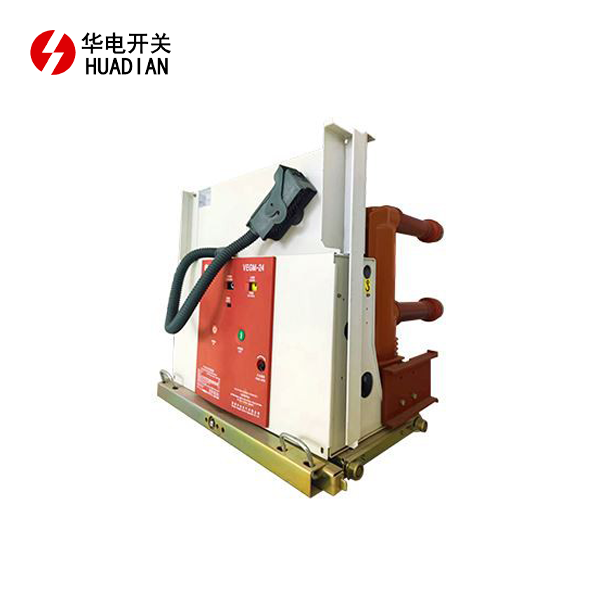
| Medium-voltage switchgear (draw-out type) | The insulation distance between phases in the cabinet is the core of the design | chamber outlet, and busbar connection methods Minimum phase-to-phase spacing, insulating barriers, and composite insulation |
| GIS (Gas-Insulated Switchgear) | The spacing is fixed by the structure, and the impact is reflected in the electric field design | Electric field optimization and the arrangement of basin-type insulators |
| Low-voltage complete switchgear assemblies | Busbar phase spacing is strongly related to short circuit tolerance | Busbar spacing and the span between supporting insulators |
Ⅳ. Engineering practice suggestions
Use the manufacturer's minimum phase spacing as a hard constraint: When selecting and designing cabinets, the minimum phase spacing marked in the product data should be regarded as an unbreakable boundary condition and should not be compressed on the grounds that "it can be installed on site".
Compact design requires supporting verification: If the phase spacing must be reduced, the manufacturer should be required to provide a breaking test report under this spacing, or use compensation measures such as derating and installing interphase insulation partitions.
Pay attention to the busbar and cable connection section: the spacing between the circuit breaker body is qualified, but the phase clearance between the incoming and outgoing busbars and cable terminals also needs to be checked to avoid "the body is qualified and the wiring section has an accident."
Check the change of spacing during operation and maintenance: busbar reset after maintenance and aging and deformation of insulation parts may change the actual phase spacing, and should be included in regular inspection items.
Distinguish between "insulation distance" and "breaking distance": the former is related to withstand voltage, and the latter is related to arc extinguishing. The two cannot replace each other and need to be checked separately.
Conclusion
Phase spacing is not merely an installation dimension; it is a fundamental prerequisite for a circuit breaker's rated breaking capacity. By understanding the underlying mechanisms-namely arc extinction, electric field distribution, and electrodynamic forces-strictly adhering to the minimum phase spacing specified by the manufacturer, and verifying the spacing of connection segments during both switchgear design and ongoing operation, one can ensure the reliability of the final line of defense: short-circuit interruption.
Contact us
If you need technical support in circuit breaker selection, switch cabinet phase spacing design or breaking capacity verification, please contact Shaanxi Huadian's professional team. We can provide you with product selection suggestions, cabinet design review and related technical consultation to help your power distribution system operate safely and reliably.
Email:pannie@hdswitchgear.com.