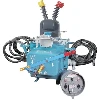
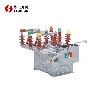
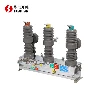
Zinc oxide arrester (MOA, Metal-Oxide Arrester) is an overvoltage protection device widely used in modern high-voltage power distribution systems. Due to its excellent nonlinear volt-ampere characteristics and rapid response capabilities, it has gradually replaced traditional silicon carbide arresters.

1. Core Function
Overvoltage Protection:
Lightning Overvoltage: Absorbs high-amplitude impact current during lightning strikes, limits line-to-ground voltage, and protects transformers, switchgear, etc.
Operation Overvoltage: Suppresses transient overvoltage caused by circuit breaker opening and closing, capacitor switching, etc.
Continuous Operation: High resistance (microampere leakage current) during normal operation, almost no energy consumption; quickly turns to low resistance during overvoltage, discharging energy.
2. Typical application scenarios in high-voltage power distribution
Substation inlet and outlet lines: installed on the high-voltage side of the transformer, busbar, and cable joints as the first line of protection.
Distribution lines: lightning-prone sections on poles or overhead lines to protect line insulators and equipment.
GIS (gas insulated switchgear): integrated into enclosed combined electrical appliances, saving space and high reliability.
Generator/motor protection: prevents rotating motors from being damaged by steep wave overvoltage.
3. Technical advantages
Non-linear characteristics: The resistance of zinc oxide resistors drops sharply under high voltage (non-linear coefficient α≈0.02~0.05), and the response time is nanoseconds.
No follow-up current: Unlike traditional lightning arresters, MOA automatically restores to a high-resistance state under power frequency voltage without cutting off the follow-up current.
Multiple protections: It can be designed as a gapless structure to reduce maintenance and withstand multiple lightning strikes.
Environmental adaptability: It is resistant to dirt and aging, suitable for harsh outdoor conditions.
4.Common fault types and manifestations
◆Deterioration of internal resistors
Symptoms:
Increased leakage current (significant increase in resistive component).
Infrared temperature measurement shows local overheating (temperature difference > 2°C, be alert).
The counter frequently operates but there is no thunderstorm.
Cause: Accumulated damage due to aging, moisture or overvoltage shock under long-term power frequency voltage.
◆ External insulation damage
Symptoms:
Surface cracks, flashover marks or explosions of porcelain sleeves.
Broken and rusted grounding lead.
Cause: Mechanical stress, dirty flashover, seal failure and water ingress.
◆Counter failure
Symptoms: Counter does not operate or malfunctions after lightning strike.
Cause: Mechanical jamming, internal coil short circuit.
◆System abnormality
Symptoms:
The explosion of the arrester causes a busbar short circuit (protection trip).
The monitor shows that the continuous leakage current exceeds the standard.
5.Fault handling process
◆ Emergency handling (when serious defects are found)
Immediate power outage: If the arrester explodes, sprays oil or continuously sprays arcs, the upper switch must be disconnected and isolated.
Temporary bypass: The important load side can be temporarily put into standby arrester or limit the operating overvoltage measures.
◆General defect handling
Mild deterioration:
Strengthen monitoring (shorten the test cycle to 3 months).
Spray RTV anti-pollution flashover paint (for surface contamination).
Counter failure: Replace the same model counter and check the grounding loop.
◆Replace the arrester
Steps:
Test electricity, hang the ground wire, and remove the lead wire.
Check the insulation resistance of the base (>500MΩ).
Before installing the new arrester, the DC parameters (U1mA, leakage current) must be tested.
Avoid mechanical stress when restoring the lead wire (use soft connection).
Selection verification:
The rated voltage and residual voltage level are consistent with the original design.
Outdoor type should not be used indoors (no explosion-proof design risk).
◆Systematic inspection
When multiple arresters from the same batch deteriorate, it is necessary to check:
Whether there is resonant overvoltage in the system.
Whether the grounding grid resistance exceeds the standard (resulting in poor discharge).
6.Preventive measures
Regular testing:
Retest after one year of operation, and then every 3-5 years (shorten the cycle in areas prone to lightning damage).
Online monitoring:
Install a wireless transmission leakage current monitoring device (such as LoRa module).
Environmental control:
Anti-pollution flashover type (large creepage distance or silicone rubber jacket) is used in areas with pollution level III or above.
Lightning protection coordination:
Combined with overhead ground wire and arc suppression coil to form multi-level protection.
contact us
If you need further technical details of zinc oxide arrester (MOA) or purchase selection suggestions, please contact us:pannie@hdswitchgear.com.