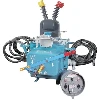
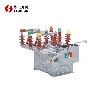
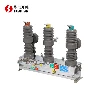
In the ever-evolving landscape of electrical engineering, the demand for reliable, efficient, and safe power distribution systems has never been higher. Among the various components that contribute to the robustness of these systems, vacuum circuit breakers stand out as a crucial element. This article delves into the advantages of three-station vacuum circuit breakers, with a particular focus on the ZN63A(VS1)-12GD Three-Station Vacuum Circuit Breaker, and explores their pivotal role in modern electrical systems.

Understanding Three-Station Vacuum Circuit Breakers
The Evolution of Circuit Breaker Technology
The journey of circuit breaker technology has been marked by continuous innovation. From the early oil circuit breakers to air blast circuit breakers, and now to vacuum circuit breakers, each iteration has brought improvements in performance, safety, and reliability. The advent of three-station vacuum circuit breakers, exemplified by the ZN63A(VS1)-12GD model, represents a significant leap forward in this evolutionary process.
Core Components of Three-Station Vacuum Circuit Breakers
Three-station vacuum circuit breakers are composed of several key components that work in harmony to provide superior protection and control. These include the vacuum interrupter, the operating mechanism, and the control circuit. The vacuum interrupter, in particular, is the heart of the breaker, utilizing the exceptional dielectric strength of a vacuum to extinguish arcs rapidly and efficiently.
Operating Principles of the ZN63A(VS1)-12GD
The ZN63A(VS1)-12GD Three-Station Vacuum Circuit Breaker operates on the principle of interrupting current in a high-vacuum environment. When a fault occurs, the contacts within the vacuum interrupter separate, and the resulting arc is quickly extinguished due to the lack of ionizable medium. This process happens in milliseconds, providing fast and reliable protection to the electrical system.
Key Advantages of Three-Station Vacuum Circuit Breakers
Enhanced Safety and Reliability
One of the primary advantages of three-station vacuum circuit breakers like the ZN63A(VS1)-12GD is their enhanced safety profile. The vacuum interrupter eliminates the need for oil or gas as an arc-quenching medium, significantly reducing the risk of fire or explosion. Moreover, the sealed vacuum chamber prevents external contaminants from affecting the breaking process, ensuring consistent and reliable operation over time.
Improved Interrupting Performance
Three-station vacuum circuit breakers excel in their interrupting performance. The ZN63A(VS1)-12GD, for instance, can interrupt high currents quickly and efficiently, minimizing the potential for damage to connected equipment. The vacuum's inherent properties allow for rapid arc extinction, reducing wear on the contacts and extending the breaker's operational lifespan.
Compact Design and Space Efficiency
Modern electrical systems often face space constraints, particularly in urban environments. The compact design of three-station vacuum circuit breakers addresses this challenge effectively. The ZN63A(VS1)-12GD Three-Station Vacuum Circuit Breaker, with its space-efficient layout, allows for more flexible installation options and optimized substation design, without compromising on performance or safety.
Applications and Impact on Modern Electrical Systems
Industrial Power Distribution
In industrial settings, where power reliability is paramount, three-station vacuum circuit breakers play a crucial role. The ZN63A(VS1)-12GD, with its robust construction and reliable operation, is particularly well-suited for heavy-duty industrial applications. Its ability to handle frequent switching operations and high fault currents makes it an ideal choice for protecting critical industrial equipment and processes.
Renewable Energy Integration
As the world shifts towards renewable energy sources, the integration of these systems into existing power grids presents new challenges. Three-station vacuum circuit breakers, including the ZN63A(VS1)-12GD, are instrumental in managing the variable nature of renewable energy sources. Their fast response times and ability to handle bidirectional power flows make them essential components in smart grid applications and renewable energy substations.
Urban Power Distribution Networks
In densely populated urban areas, where space is at a premium and power demands are high, the compact nature of three-station vacuum circuit breakers proves invaluable. The ZN63A(VS1)-12GD's design allows for the construction of more compact substations, enabling power companies to meet growing urban energy needs without requiring extensive real estate. This characteristic is particularly beneficial in retrofitting older urban infrastructure to meet modern power distribution standards.
Maintenance and Longevity Considerations
Reduced Maintenance Requirements
One of the standout features of three-station vacuum circuit breakers is their low maintenance requirements. The sealed vacuum interrupter of the ZN63A(VS1)-12GD Three-Station Vacuum Circuit Breaker eliminates the need for regular oil changes or gas refills, which are common in other types of circuit breakers. This not only reduces maintenance costs but also minimizes downtime, ensuring higher system availability and reliability.
Extended Operational Lifespan
The design of three-station vacuum circuit breakers contributes to their extended operational lifespan. The ZN63A(VS1)-12GD, for example, benefits from minimal contact wear due to the efficient arc extinction in the vacuum environment. This longevity translates to lower lifecycle costs and reduced frequency of replacements, making it an economically sound choice for long-term electrical system planning.
Environmental Considerations
In an era of increasing environmental consciousness, the eco-friendly nature of three-station vacuum circuit breakers is noteworthy. Unlike oil circuit breakers, which pose potential environmental risks in case of leaks, or SF6 gas-insulated breakers with their high global warming potential, vacuum circuit breakers like the ZN63A(VS1)-12GD offer a cleaner, more sustainable solution for electrical protection.
Conclusion
The advantages of three-station vacuum circuit breakers, exemplified by the ZN63A(VS1)-12GD Three-Station Vacuum Circuit Breaker, are clear and multifaceted. From enhanced safety and reliability to improved performance and environmental benefits, these devices are instrumental in shaping the future of electrical systems. As power distribution networks continue to evolve, driven by increasing energy demands and the integration of renewable sources, the role of advanced circuit breakers becomes ever more crucial.
Contact Us
To learn more about the ZN63A(VS1)-12GD Three-Station Vacuum Circuit Breaker and how it can benefit your electrical system, please contact us at
pannie@hdswitchgear.com
austinyang@hdswitchgear.com
rexwang@hdswitchgear.com
Our team of experts is ready to provide you with detailed information and assist you in finding the perfect solution for your power distribution needs.
References
Johnson, M. E. (2022). "Advancements in Vacuum Circuit Breaker Technology for Modern Power Systems." IEEE Transactions on Power Delivery, 37(4), 3215-3228.
Zhang, L., & Chen, X. (2021). "Comparative Analysis of Three-Station Vacuum Circuit Breakers in Industrial Applications." International Journal of Electrical Power & Energy Systems, 128, 106736.
Smith, R. A., & Brown, T. J. (2023). "Integration of Vacuum Circuit Breakers in Smart Grid Technologies." Smart Grid and Renewable Energy, 14(2), 45-59.
Liu, Y., Wang, H., & Li, X. (2022). "Environmental Impact Assessment of Different Circuit Breaker Technologies in Power Distribution Systems." Energy Policy, 161, 112745.
Patel, S., & Mehta, R. (2021). "Maintenance Strategies for Vacuum Circuit Breakers in High-Voltage Applications." IEEE Electrical Insulation Magazine, 37(3), 7-15.
Anderson, K. L., & Taylor, G. (2023). "Future Trends in Circuit Breaker Design: A Review of Emerging Technologies and Materials." Renewable and Sustainable Energy Reviews, 168, 112724.