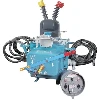
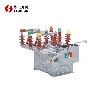
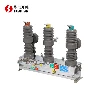
Overview:
The vacuum interrupter is the core component of the medium and high voltage power switch. Its main function is to quickly extinguish the arc and suppress the current after the medium and high voltage circuit breaker is cut off through the excellent insulation of the vacuum in the tube to avoid accidents.
The vacuum interrupter is mainly used in power transmission and distribution control system, also used in metallurgy, mining, petroleum, chemical, railway, broadcasting, communications, industrial high-frequency heating and other power distribution systems. It has the characteristics of energy saving, material saving, fire prevention, explosion-proof, small size, long life, low maintenance cost, reliable operation and no pollution.

Type:
Vacuum interrupters are divided into arc interrupters for vacuum circuit breakers and arc interrupters for load switches. Vacuum circuit breaker interrupters are mainly used in substations and grid facilities in the power sector, Arc interrupters for load switches are mainly used for end users of the power grid.
Structure:
Vacuum interrupter is mainly composed of airtight insulating shell, conductive circuit, shielding system, contacts, bellows and other parts to form a ceramic shell vacuum interrupter.

Air tight insulation system:
The airtight insulating shell made of glass or ceramics, the moving end cover, the fixed end cover, and the stainless-steel bellows form an airtight insulating system.
In order to ensure good air tightness between glass, ceramics and metal, in addition to strict operation process during sealing, it is also required that the gas permeability of the material itself should be as small as possible and the internal air release should be limited to a minimum value.
The stainless-steel bellows can not only isolate the vacuum state inside the vacuum interrupter from the external atmospheric state, but also enable the moving contact and the moving conductive rod to move within a specified range to complete the closing and breaking operations of the vacuum switch.
Conductive system:
The fixed conductive rod, the fixed arc surface, the fixed contact, the movable contact, the movable arc surface and the movable conductive rod constitute the conduction system of the arc extinguishing chamber.
Among them, the fixed conducting rod, the fixed arc surface and the fixed contact are collectively called the fixed electrode, and the moving contact, the moving arc surface, and the moving conducting rod are collectively called the moving electrode, the vacuum circuit breaker assembled by the vacuum interrupter, and the vacuum load switch When closing with the vacuum contactor, the operating mechanism closes the two contacts through the movement of the moving conductive rod, completing the connection of the circuit.
In order to reduce the contact resistance between the two contacts as much as possible and keep it stable and to have good mechanical strength when the arc extinguishing chamber is subjected to dynamic and stable current, the vacuum switch is provided with a guide sleeve at one end of the moving conductive rod, and uses a set of compression springs. Maintain a rated pressure between the two contacts. When the vacuum switch breaks the current, the two contacts of the arc extinguishing chamber are separated and an arc is generated between them, and the arc is extinguished when the current naturally crosses zero, and the circuit breaking is completed.

Shielding system:
The shielding system of the vacuum interrupter is mainly composed of shielding cylinder, shielding cover and other parts.
The main functions of the shielding system are:
1. Prevent the contacts from producing a large amount of metal vapor and droplet splashing during the arcing process, polluting the inner wall of the insulating housing, and avoiding the reduction of the insulating strength of the vacuum interrupter housing or flashover.
2. Improve the electric field distribution inside the vacuum interrupter, which is beneficial to the miniaturization of the vacuum interrupter insulation shell, especially for the miniaturization of the high-voltage vacuum interrupter.
3. Absorb part of the arc energy and condense arc products. Especially when the vacuum interrupter is breaking short-circuit current, most of the heat energy generated by the arc is absorbed by the shielding system, which is beneficial to improve the recovery strength of the medium between the contacts. The greater the amount of arc products absorbed by the shielding system, the greater the energy absorbed by the shielding system, which has a good effect on increasing the breaking capacity of the vacuum interrupter.
Contact system:
The contact is the part where the arc is generated and extinguished, and the requirements for the material and structure are relatively high.
There are the following requirements for the contact material:
1. High breaking capacity. The material itself is required to have high electrical conductivity, small thermal conductivity, large heat capacity and low thermionic emission capability.
2. High breakdown voltage. The higher the breakdown voltage, the higher the dielectric recovery strength, which is beneficial to arc extinguishing.
3. High resistance to electrical corrosion. That is, it can withstand the ablation of the arc, and the amount of metal evaporation is small.
4. Anti-welding ability.
5. Low cut-off current value, hopefully below 2.5A.
6. Low gas content. Among them, low gas content is a requirement for materials used inside all vacuum interrupters. Especially for copper, oxygen-free copper with low gas content must be required for special processing. The solder, etc. are made of silver and copper alloys.
The contact materials of vacuum interrupters for circuit breakers are mostly copper-chromium alloys, with copper and chromium each accounting for 50%. A copper-chromium alloy sheet is welded on the butt surfaces of the upper and lower contacts, and the thickness is generally 3mm. The rest is called the contact seat, which can be made of oxygen-free copper.
Working principle:
The vacuum interrupter is an electric vacuum device that uses a high vacuum working insulating arc extinguishing medium and relies on a pair of contacts sealed in the vacuum to realize the on-off function of the power circuit.
When it disconnects a certain amount of current, at the moment of separation of the moving and static contacts, the current shrinks to the point where the contacts have just separated, and the resistance between electrodes increases dramatically and the temperature increases rapidly until the electrode metal evaporates and forms at the same time. The extremely high electric field strength leads to extremely strong emission and gap breakdown, resulting in a vacuum arc.
When the power frequency current is close to zero, it is also the increase of the contact distance, and the plasma of the vacuum arc quickly spreads around. After the arc current crosses zero, the medium in the contact gap quickly changes from a conductor to an insulator, so the current is interrupted. Due to the special structure of the contacts, a proper longitudinal magnetic field will be generated in the contact gap during arcing.
This magnetic field can make the arc evenly distributed on the contact surface and maintain a low arc voltage, so that the vacuum interrupter has a higher arc. After the dielectric strength recovery speed, small arc energy and small corrosion rate. In this way, the ability and service life of the vacuum interrupter to interrupt the current are improved.