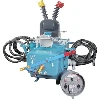
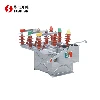
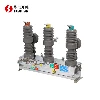
ZN63(VS1) is one of the most common indoor medium-voltage vacuum circuit breaker models in China. Its operating mechanism usually adopts a spring energy storage mechanism, and the electromagnets of the opening and closing coils are the "electric trigger switches" that control the release of spring energy and realize the opening and closing operations.

I. Structural Composition
The opening and closing coils are structurally similar, both being solenoid-type DC electromagnets, mainly composed of the following parts:
Iron Core (Stationary Iron Core):Made of soft magnetic material (such as silicon steel sheets or low-carbon steel), fixed to the frame, it is the main component of the magnetic circuit.
Coil (Excitation Coil):A winding made of insulated copper wire wound on the frame. The coil resistance is typically tens to over one hundred ohms (common values are ≈44Ω, ≈88Ω, ≈220Ω, etc.), with rated voltages such as DC110V and DC220V. The coil has external insulation protection and markings (such as "Closed" and "Opened").
Armature (Moving Iron Core):Also made of soft magnetic material, located inside the coil, it can move axially. It is the direct object of electromagnetic force.
Reaction Spring:Usually a compression spring, installed at or around the tail of the armature. Its functions are:
For the closing coil: Maintains the armature in the reset position when not energized; helps the armature quickly reset after the closing operation.
For the opening coil: Provides a force opposite to the electromagnetic force, ensuring the circuit breaker remains closed when no opening signal is received; resets the armature after opening.
Push rod or drive rod: Rigidly connected to the armature. When the armature is attracted, the push rod moves forward, impacting or pushing the locking device or tripping half-shaft of the operating mechanism, thereby releasing the energy of the energy storage spring and completing the operation.
Yoke/Carcass: Forms a complete magnetic circuit and serves as mechanical support and protection for the coil and core.
II. Working Principle (Core: Electromagnetism → Magnetic Force → Mechanical Trigger)
The working principle can be summarized as an "electromagnetic-mechanical" conversion chain. The following details the closing process as an example (the opening process is completely symmetrical):
Preparation State:
The circuit breaker is in the open state, and the closing spring is energized (by motor or manual operation).
The armature of the closing coil is in the retracted position under the action of the return spring, and the push rod has not touched the closing latch of the mechanism.
The closing circuit is in the open state.
Electrification Excitation:
When a closing command is received (e.g., a signal from the protection device or a manual button press), the closing circuit is connected, and a direct current flows through the closing coil.
The current generates a strong circular magnetic field around the coil.
Magnetic Circuit and Attraction Generation:
The magnetic field forms a closed magnetic circuit through the iron core, the air gap (between the coil and the armature), the armature, and the outer casing.
According to electromagnetic principles, the magnetic field will exert an attractive force (electromagnetic attraction) on the magnetic material (armature) within it. The magnitude of this force is related to the square of the current, the number of coil turns, the magnetic circuit structure, etc., and the design must be sufficient to overcome the pressure and frictional resistance of the reaction spring.
Mechanical Action and Triggering:
Under the powerful electromagnetic attraction, the armature is rapidly pulled towards the iron core, moving in a linear axial motion.
The push rod, integrated with the armature, then forcefully strikes the closing latch (or closing half-shaft) of the operating mechanism.
This impact releases the latch that was originally locking the closing spring (or closing latch) (commonly known as "tripping").
Energy Release and Completion of Operation:
Once the latch is released, the stored energy of the closing spring is immediately released, pushing the circuit breaker's transmission linkage and insulating pull rod, causing the moving contact of the vacuum interrupter to move rapidly upward and close with the stationary contact, completing the closing operation.
Reset:
After the closing command ends (usually a short pulse signal, approximately tens to hundreds of milliseconds), the coil is de-energized, and the magnetic field disappears.
The force of the return spring pushes the armature and push rod back to their initial positions, preparing for the next operation.
The tripping process is exactly the same, except that the triggering object is the tripping latch, and the energy of the tripping spring (or contact pressure spring) is released to separate the moving contact.
III. Key Features and Precautions
Short-time Operation: The closing and tripping coils are designed for momentary energization (typically <1 second). Prolonged energization will cause overheating and burnout. A reliable self-cutting device must be included in the control circuit.
Power Supply Requirements: DC operating power supply is required. The voltage must be within 85%-110% of the rated value for reliable operation. Insufficient voltage may result in insufficient suction force ("failure to operate"), while excessive voltage may burn out the coil or cause excessive impact force.
Mechanism Coordination: The electromagnet itself only provides the "triggering" force; the actual closing and tripping power comes from the pre-stored energy in the spring. Therefore, it is a control element, not a power source.
Typical Position in the VS1 Mechanism: In the VS1 type spring-operated mechanism, the closing coil is usually horizontally arranged, impacting the closing half-shaft; the tripping coil can be horizontal or vertically arranged, impacting the trip unit or half-shaft.
Common Faults:
Coil Burnout: Mostly due to the auxiliary switch not being switched, causing the coil to remain energized for an extended period.
Failure to operate: Caused by low power supply voltage, open or short circuit in the coil, armature jamming, excessively tight return spring, or inflexible locking mechanism.
Misoperation: Operates when it should not, possibly due to wear on the locking latch, insulation problems in the secondary circuit leading to accidental energization, etc.
Summary
The opening and closing coil electromagnet of the ZN63(VS1) vacuum circuit breaker is essentially a precision electromagnetic actuator that converts electrical energy into linear mechanical impact force, controlled by current. Its core function is to accurately and reliably trigger the locking system of the spring-operated mechanism, thereby controlling the release of the large spring energy stored as instructed, ultimately achieving the rapid opening and closing of the circuit breaker contacts. Its structure is simple but requires high reliability, making it a crucial link in ensuring the circuit breaker correctly executes protection and control commands.
Shaanxi Huadian vacuum circuit breakers feature fully enclosed, maintenance-free spring-operated or permanent magnet mechanisms, offering fast opening and closing speeds with minimal time dispersion. They utilize high-quality vacuum interrupters, maintaining vacuum levels for life without maintenance. These circuit breakers boast strong breaking capacity and are explosion-proof and pollution-free. Inquiries are welcome.
Email:pannie@hdswitchgear.com.
Whatsapp/Wechat:+8618789455087