Indoor and outdoor high-voltage vacuum circuit breakers have similar core functions, both used to protect and control power systems. However, due to differences in usage environments, there are significant differences in design, protection, and installation methods. The following is a specific comparison:

What is an indoor high-voltage circuit breaker?
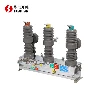
Indoor circuit breakers are high-voltage switchgear suitable for use inside buildings, but are not designed to withstand wind, rain, snow, dirt, condensation, ice, and frost.
What is an outdoor high-voltage circuit breaker?
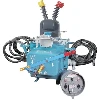
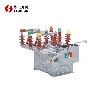
Outdoor circuit breakers are high-voltage switchgear suitable for outdoor use, and can withstand wind, rain, snow, dirt, condensation, ice, and frost.
Similarities
Arc Extinguishing Principle: Both utilize a vacuum interrupter (vacuum tube) to interrupt the current, and a high vacuum dielectric to insulate and extinguish the arc.
Basic Function: Provides circuit switching, load control, and short-circuit protection.
Core Components: Both include a vacuum interrupter, operating mechanism (spring/electromagnetic), and insulating support.
Differences
| Comparison Items | Indoor High-Voltage Vacuum Circuit Breakers | Outdoor High-Voltage Vacuum Circuit Breakers |
|---|---|---|
| Operating environment | Installed in indoor environments such as distribution rooms and substations, without direct exposure. |
Exposed to the outdoors, they must withstand wind, rain, snow, UV rays, and dirt. |
| Protection level | Usually IP20-IP40 rated, primarily for dust protection. |
At least IP54, emphasizing waterproofing and corrosion resistance. |
| Insulation design | Relies on airflow and insulators, and requires a dry and clean environment. |
Reinforced insulation (such as silicone rubber jackets) and anti-condensation design are required. |
| Mechanical strength | Requires less wind and seismic resistance. |
Strong structures are required to withstand strong winds, ice, and snow loads. |
| Temperature adaptability | Narrow operating temperature range (e.g., -5°C to 40°C). |
Wide operating temperature range (e.g., -30°C to 60°C) is required to accommodate extreme climates. |
| Installation method | Fixed in switchgear, requires a protective enclosure. |
Separately mounted on a pole or platform, often in combination with a disconnect switch. |
| Maintenance convenience | Ensures a clean environment and low maintenance. |
Regular cleaning of dirt and inspection of seals are required. |
| Typical models | ZN63A (VS1), ZN85, etc. ("N" stands for indoor). | ZW32, ZW8, etc. ("W" stands for outdoor use). |
Selection Recommendations
Indoor: Prioritize compactness and switchgear compatibility, such as center-mounted circuit breakers (VS1).
Outdoor: Focus on environmental durability and choose a pole-mounted circuit breaker with an isolating knife switch (such as the ZW32-12F).
Key Differences
Outdoor circuit breakers require specialized design for sealing, mechanical strength, and wide operating temperature ranges, and are generally more expensive than indoor circuit breakers. The two are not directly interchangeable; selection must be carefully tailored to the installation environment.
If you need to know more about high-voltage vacuum circuit breaker products or related services, please contact us through the following methods. We will provide you with professional technical support and solutions:
Email:pannie@hdswitchgear.com
Whatsapp/Wechat:+8618789455087