A pole-mounted circuit breaker (PBT) is a mechanical switching device installed on outdoor poles in 10kV overhead power distribution lines. Used in urban and rural power distribution networks, it is used to disconnect, close, and carry line load current and fault current. A conventional pole-mounted circuit breaker (PBT) mainly consists of a switch body and a feeder unit (FTU). A complete primary and secondary integrated pole-mounted circuit breaker typically consists of a switch body with sensors and a feeder unit (FTU).
1. Classification of Pole-Mounted Switches
By Breaking Capacity:
a. Pole-Mounted Disconnect Switch: Cannot close or interrupt normal load current, has a clear break, used for isolating line maintenance.
b. Pole-Mounted Load Switch: Can close, carry, and interrupt normal load current (≤630A), and can carry but cannot interrupt fault current.
c. Pole-Mounted Circuit Breaker: Can close, carry, and interrupt normal load current (≤630A) and fault current (≥20kA).
d. Pole-Mounted Fuse: Used to interrupt short-circuit current and protect the line.
Arc Extinguishing Method: Vacuum arc extinguishing, SF6 arc extinguishing, oil arc extinguishing (obsolete)
Insulation Method: Air insulation, SF6 gas insulation, composite insulation, oil insulation (obsolete)
Based on the controller it is equipped with, it is divided into:
a. Boundary type switch: Built-in zero-sequence current transformer, with zero-sequence protection function, equipped with load switch or circuit breaker
b. Voltage type load switch: Can automatically open and close according to the voltage changes of the lines on both sides
c. Centralized type load switch: Cannot actively interrupt short-circuit current.
SF6 insulating gas is a colorless, odorless, non-toxic, and non-flammable gas with excellent electrical insulation and arc-extinguishing properties. Its density is 5 times that of air, making it difficult to leak.
2. Pole-Mounted Disconnect Switch
A pole-mounted disconnect switch, also known as a disconnecting knife switch, is a control electrical device without an arc-extinguishing device. Its main function is to isolate the power supply to ensure the safe maintenance of other electrical equipment; therefore, it is not allowed to operate under load. However, under certain conditions, it is permissible to connect or disconnect small-power circuits. It is one of the most frequently used electrical devices in high-voltage switches.
Pole-mounted disconnect switches can be used for power outage maintenance, fault finding, cable testing, and reconfiguration of operating modes for line equipment. Opening the pole-mounted disconnect switch isolates the equipment requiring maintenance from other operating lines, establishing a reliable insulation gap and providing workers with a clearly visible disconnection mark, ensuring the safety of maintenance or testing work. The advantages of pole-mounted disconnect switches are low cost, simplicity, and durability. They are generally used as property boundary switches between overhead lines and users, as well as between cable lines and overhead lines. They can also be installed on one or both sides of the line tie load switch to facilitate fault finding, cable testing, and maintenance/replacement of the tie load switch.
Disconnect switches cannot be operated under rated load or large load, and cannot switch between load current and short-circuit current. During normal power-on operations, close the disconnecting switch first, then close the circuit breaker or load switch; during power-off operations, open the circuit breaker or load switch first, then open the disconnecting switch.
Disconnecting switches can reliably carry operating current and short-circuit current, but cannot interrupt load current. They can open and close unloaded transformers with an excitation current not exceeding 2A and unloaded lines with a capacitance current not exceeding 5A. The dynamic stability current of a disconnecting switch generally does not exceed 40kA; careful verification should be performed during selection. The operating life of a disconnecting switch is approximately 2000 cycles.
3. Pole-Mounted Load Switches
Pole-mounted load switches are control electrical appliances with simple arc-extinguishing devices that can open and close circuits under load. They can switch on and off certain load currents and overload currents, but cannot interrupt short-circuit currents. They must be used in series with a high-voltage fuse to interrupt the short-circuit current.
Load switches are a type of switching device between disconnect switches and circuit breakers, mainly used for line segmentation and fault isolation.
Load switches mainly include gas-generating load switches, vacuum load switches, and SF6 load switches. Gas-generating load switches utilize a slit made of solid gas-generating material to generate a large amount of gas under the action of an electric arc, forming a gas blowout to extinguish the arc. Due to their simple structure and low cost, they were once widely used. Vacuum and SF6 load switches are similar in appearance and parameters to vacuum and SF6 circuit breakers, but the difference is that load switches do not have protective current transformers (CTs) and cannot interrupt short-circuit currents, but they can withstand and close short-circuit currents. They have long service life, are maintenance-free, and have a mechanical life and rated current breaking cycles of over 10,000 times, making them suitable for frequent operation.
Pole-mounted load switches commonly used in operation are generally vacuum load switches. Vacuum load switches employ vacuum arc extinguishing, SF6 insulation, three-phase common enclosure design, VSP5 electromagnetic or spring operating mechanism, and can have an internal current transformer. Cable or terminal outlets are available, and an internal isolating device can be installed. They can be suspended or mounted. See the diagram below.
Alternatively, SF6 pole-mounted load switches are also widely used. SF6 load switches employ SF6 arc extinguishing, SF6 insulation, three-phase common enclosure design, and can have an internal current transformer. Cable or terminal outlets are available, and external isolating devices can be optionally installed. They can be suspended or mounted.
4. Pole-Mounted Circuit Breaker
A circuit breaker is a switching device capable of closing, carrying, and interrupting current under normal circuit conditions, and capable of closing, carrying, and interrupting current under abnormal circuit conditions within a specified time. Circuit breakers can be used to distribute electrical energy, infrequently start asynchronous motors, protect power lines and motors, and automatically disconnect the circuit when serious overloads, short circuits, or undervoltage faults occur. Its function is equivalent to a combination of a fuse switch and over/under-temperature relays.
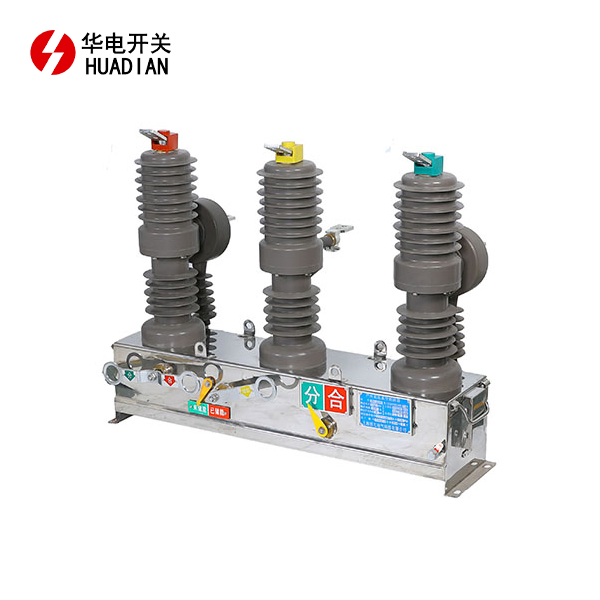
A pole-mounted circuit breaker is a circuit breaker installed and operated on a utility pole, commonly known as a "watchdog." It is a switching device that can disconnect or connect a line under normal conditions, and manually or automatically switch the faulty line to another line when a short circuit fault occurs, through operation or the action of a relay protection device. The main difference between a circuit breaker and a load switch is that a circuit breaker can interrupt short-circuit current. Pole-mounted circuit breakers are mainly used for sectional switching, control, and protection of power distribution lines, and can interrupt and close short-circuit current.
Pole-mounted circuit breakers can be classified according to the arc-extinguishing medium they use: oil circuit breakers (basically obsolete), sulfur hexafluoride (SF6) circuit breakers, and vacuum circuit breakers.
Previously, both SF6 and vacuum circuit breakers were commonly used in distribution network projects. Now, outdoor AC high-voltage intelligent vacuum circuit breakers are the primary choice for distribution lines. Intelligent vacuum circuit breakers possess fault detection, protection control, and communication functions. They are generally installed at the responsibility demarcation point of 10kV overhead lines and can automatically disconnect, handle single-phase grounding, and isolate short-circuit faults, making them ideal for distribution line upgrades and distribution network automation.
Intelligent vacuum circuit breakers can be operated manually, electrically, remotely, or remotely from a host computer. The circuit breaker consists of three parts: the main body, the operating mechanism, and the controller (which may include a built-in isolating switch). Depending on the needs, the circuit breaker can be configured with CTs (protective current transformers), ZCTs (zero-sequence current transformers), and u (voltage transformers) as detectors for the controller.
Vacuum circuit breakers are classified into SF6 insulated vacuum circuit breakers and air-insulated vacuum circuit breakers based on their insulation material. SF6 insulated vacuum circuit breakers utilize vacuum arc extinguishing, SF6 insulation, three-phase common-enclosure design, and a spring-operated mechanism. The current transformer can be internally mounted, with cable or terminal outlets. External isolation devices are optional, and they can be suspended or mounted. Air-insulated vacuum circuit breakers utilize vacuum arc extinguishing, air insulation, three-phase fixed-pole design, and a spring or permanent magnet operating mechanism. The current transformer is externally mounted, with terminal outlets, and external isolation devices are optional. They are mounted on a bench.
5. Drop-out Fuses
Drop-out fuses, commonly known as Lynk & Co., are the most common type of short-circuit protection switch used in 10kV distribution line branches and distribution transformers. They are economical, easy to operate, and highly adaptable to outdoor environments, and are widely used on the primary side of 10kV distribution lines and distribution transformers for protection and equipment switching operations.
When installed on 10kV distribution line branches, drop-out fuses can reduce the scope of power outages. Because they have a clearly visible breaking point, they function as disconnecting switches, creating a safe working environment for the lines and equipment under maintenance and increasing the safety of maintenance personnel. When installed on distribution transformers, they can serve as the main protection for the transformers, hence their widespread use in 10kV distribution lines and distribution transformers.
Fuses can be installed on either the power supply side or the receiving side of a load switch. When frequent fuse replacement is not required, the former arrangement is preferable, allowing the load switch to function as a disconnector to isolate the voltage applied to the current-limiting fuse.
The main components of a drop-out fuse include an insulator, lower support base, lower moving contact, lower stationary contact, mounting plate, upper stationary contact, duckbill, upper moving contact, and fuse tube.
6. Differences between Pole-Mounted Switches
The main differences are as follows:
Disconnecting switches lack an arc-extinguishing device, so they are only suitable for interrupting no-load current. They cannot interrupt load current or short-circuit current. Therefore, disconnecting switches can only be safely operated when the circuit is safely disconnected, and operation under load is strictly prohibited to avoid safety accidents.
Load switches have an arc-extinguishing device and possess a certain arc-extinguishing capability, but it is not as strong as that of circuit breakers. They can switch normal operating currents, but in the event of a short circuit, they can only silently withstand the short-circuit current. If manually or electrically tripped under these conditions, an explosion may occur. Therefore, load switches are generally used in conjunction with current-limiting fuses (load switch + fuse is not a standard configuration and can also be used without a fuse). In the event of overload or short circuit, the fuse disconnects the circuit. To save costs, a load switch + fuse can replace a circuit breaker.
Circuit breakers have a strong arc-extinguishing capability and can switch normal operating currents as well as fault currents. The protection function of a circuit breaker is achieved through a relay protection device. High-voltage circuit breakers lack the thermal tripping, magnetic tripping, and undervoltage tripping devices of low-voltage circuit breakers. Whether a line is faulty is determined by the relay protection device, and the circuit breaker only performs tripping according to the relay protection instructions. Load switches and isolating switches cannot interrupt fault current, so they do not require instructions during line faults. A circuit breaker is a switch with strong arc-extinguishing capability and must be used in conjunction with a relay protection device.
From this, we can conclude the following:
Isolating Switch – Can only interrupt and connect the system's no-load current and serves as a clearly visible disconnection point in the main wiring system, acting as a clearly visible disconnection point during maintenance. Common models: GW9, HGW9, GW4, GW5, etc.
Load Switch – Can interrupt and connect the system's normal load current, but cannot interrupt the system's fault current. Common model: FZW32
Circuit Breaker – In addition to interrupting and connecting the system's normal load current, it can also interrupt and connect the system's fault and short-circuit currents. Commonly used models: ZW32, ZW20, ZW7, ZW8, LW3, etc.
Contact Us
Shaanxi Huadian - a professional manufacturer of disconnect switches, load switches, circuit breakers and fuses. Welcome to contact us with your drawings or inquiries. We will provide you with a quote and service as soon as possible!
Email:pannie@hdswitchgear.com.
Whatsapp/Wechat:+8618789455087