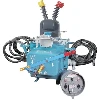
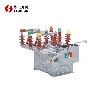
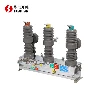
Handcart (usually called "handcart" or "circuit breaker handcart" in Chinese) is a movable modular structure in medium and high voltage switchgear (such as KYN, GZS and other models), mainly used to install and support circuit breakers (Circuit Breaker) or other electrical equipment (such as disconnectors, voltage transformers, etc.). Its core feature is that the switchgear can be pulled out or pushed in, which is convenient for maintenance, replacement or testing without disassembling the entire cabinet.

Association between handcart and circuit breaker
Function combination
The handcart is the carrier of the circuit breaker, and the circuit breaker is fixed on the handcart to form a movable unit.
By swinging the handcart in (connecting the main circuit) or out (disconnecting the isolation), the circuit breaker can switch between the working position (closing), test position (testing) and exit position (maintenance).
Typical application scenarios
Medium voltage switchgear (such as 10kV~35kV): Commonly used in cabinets such as KYN28A-12 and GZS1, circuit breakers (such as VS1 vacuum circuit breakers) are installed on the handcart.
High-voltage GIS equipment: Some SF₆ circuit breakers also adopt a trolley design, but the structure is more complex.
Advantages
Quick maintenance: When the circuit breaker fails, the trolley can be directly pulled out for replacement to reduce power outage time.
Safety: The trolley has a mechanical interlocking function to ensure that the circuit breaker is only operated in the correct position (such as being unable to close the circuit breaker when exiting).
Standardization: The interface between the trolley and the switch cabinet is unified and compatible with the same model of circuit breakers.
Key structures of the trolley
| Component | Function |
| Chassis frame | Supports the circuit breaker with rollers or guide rails for easy pushing and pulling. |
| Contact arm/plum blossom contact | Docking with the switch cabinet busbar to transmit current (reliable contact must be ensured in the working position). |
| Mechanical interlocking | Prevents misoperation (such as the trolley cannot be moved when the circuit breaker is not opened). |
| Position indication | Displays the "working/testing/isolation" status (usually through limit switches or mechanical signs). |
Example: Workflow of trolley-type SF₆ circuit breaker in switch cabinet
Operation status: The trolley is pushed into the "working position", the circuit breaker contacts are tightly connected to the busbar in the cabinet, and the circuit breaker can be opened and closed normally.
Test status: The trolley is pulled to the "test position", the circuit breaker is disconnected from the main circuit, but the secondary control circuit is still energized, and the protection test can be performed.
Maintenance status: The trolley is completely withdrawn from the cabinet, and the circuit breaker is completely isolated, which is convenient for maintenance or replacement.
Difference from fixed circuit breakers
| Characteristics | Handcart circuit breaker | Fixed circuit breaker |
| Installation method | Movable, modular design | Directly fixed to the cabinet, not movable |
| Maintenance efficiency | Quick replacement, reducing power outage time | Busbar needs to be disassembled, maintenance is complicated |
| Cost | High (due to the handcart structure) | Low |
| Application scenario | Medium voltage switch cabinet (such as 10kV power distribution) | Low voltage cabinet or part of high voltage cabinet |
Summary
Handcart is the core component of the switch cabinet to realize flexible installation and maintenance of circuit breakers, especially suitable for occasions that require frequent maintenance or rapid fault handling. Its combination with circuit breakers significantly improves the reliability and operability of the power system, and is a typical design of modern medium voltage distribution systems.For more information, please contact:pannie@hdswitchgear.com.