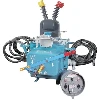
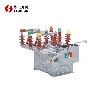
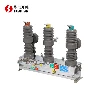
Outdoor high-voltage vacuum circuit breakers require close monitoring during operation to ensure their safety and stability. The following are key areas of focus during operation, which can be summarized as "listening, observing, measuring, and recording."

Operating Status Monitoring (Core of Daily Inspections)
Listening for Abnormal Sounds
Normal Sounds: During opening and closing operations, there will be a crisp sound of the mechanism operating and a slight sound of the electromagnet engaging.
Abnormal Sounds:
Internal Discharge Sounds: If you hear a "hissing" or "crackling" discharge sound inside the circuit breaker, report it immediately! This may be a precursor to a serious fault, such as internal insulation damage or a loss of vacuum.
Abnormal Mechanism Sounds: During opening and closing, unusual metal friction or impact sounds such as sticking or banging within the mechanism box may indicate wear, deformation, or binding of mechanical components such as springs, connecting rods, and pins.
Check the status (visual inspection)
◆Indicator status:
Open/Closed position indication: Must be consistent with the actual line status and correspond to the control room signal.
Charge indication: For spring mechanisms, the indicator should display "Charged" after charge completion. Be vigilant if charge failure or frequent charge occurs.
◆Appearance condition:
Flashover and creepage: Check the surface of the insulator (porcelain bottle) for cleanliness, cracks, damage, and discharge marks caused by contamination.
Electrical connection points: Inspect the lead connectors and terminal blocks for overheating, reddening, deformation, or abnormal color (such as blackening or oxidation). Perform a nighttime inspection with the lights off to check for hot or red spots.
Seals and corrosion: Check the seals of the mechanism box and circuit breaker body for signs of water ingress and condensation. Check the box for severe rust.
Electrical Parameter and Signal Monitoring
Protection and Signal Indication
Action Counter: Records the number of circuit breaker operations, providing an important basis for assessing its electrical and mechanical lifespan.
SF6 Gas Pressure (if applicable): Some outdoor circuit breakers use SF6 gas as external insulation. Monitor the pressure gauge to ensure it is within the normal green range. Low pressure will trigger an alarm or even a lockout.
Intelligent Device Alarms: For intelligent circuit breakers, pay close attention to any alarm signals from the intelligent control unit, such as "energy storage timeout," "coil overcurrent," and "low SF6 pressure."
Secondary Circuit Monitoring
Operating Power Supply: Ensure the control circuit power supply voltage is normal. Undervoltage may cause opening and closing failures; overvoltage may burn out the coil.
Avoid frequent operation: Allow sufficient time for the mechanism to store energy and cool after operation. Frequent operation will shorten the electrical life and may cause the motor or coil to overheat.
Operating Environment Monitoring
Surrounding Environment
Obstacle Removal: Ensure that there are no weeds, branches, bird nests, or other foreign objects around the circuit breaker, and maintain a safe distance.
Extreme Weather: After heavy rain, snow, freezing weather, or strong winds, special inspections should be strengthened to check the seals of the mechanism box, the operating condition of the heater, and any ice buildup on the exterior.
Principles for Handling Abnormal Situations
After a short-circuit fault trips:
Even if automatic reclosing is successful, this should be considered a priority inspection.
Record the fault current and tripping information.
If conditions permit, schedule a power outage for inspection, focusing on the main circuit resistance and mechanical properties, as high short-circuit currents may damage the contacts.
Immediately shut down and report any of the following situations:
An internal discharge sound or abnormal popping noise is heard.
Severe insulator damage or ground breakdown or flashover.
Abnormal color (e.g., reddish) or cracks on the surface of the vacuum interrupter.
Severe mechanism jamming, preventing opening and closing.
Severe overheating, smoke, or fire.
Summary: Key considerations during operation
| Category |
Key Focus |
Potential risks |
|---|---|---|
| Sound |
Internal discharge sound, mechanism jamming sound |
Vacuum failure, insulation breakdown, mechanical failure |
| Appearance |
Indicator, insulator, connection point, seal |
Misjudgment of status, insulation degradation, overheating and burnout, moisture in the enclosure |
| Signal |
Protection action, intelligent alarm, pressure/energy storage indicator |
Hidden faults, functional failure |
| Environment |
Foreign objects, extreme weather conditions |
Short circuit, external damage, performance degradation |
| Recording | Actuation times, fault history | Inability to perform lifespan prediction and condition-based maintenance |
Any minor anomaly could be a precursor to a serious malfunction. Maintaining vigilance during operation and meticulous inspections and monitoring can nip hidden dangers in the bud and ensure the safe and stable operation of the power grid. All operations must strictly adhere to safety regulations, and unauthorized operation is strictly prohibited.
Shaanxi Huadian offers a full range of outdoor high-voltage vacuum circuit breakers from 12kV to 40.5kV, and can also provide customized development. Deeply involved in China's power construction, our products are distributed throughout the country and have been tested by both the market and time. Choosing us means choosing the dual guarantee of technology and quality. Welcome to inquire!
Email:pannie@hdswitchgear.com.
Whatsapp/Wechat:+8618789455087