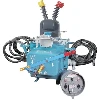
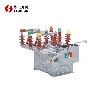
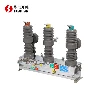
The circuit resistance of outdoor high-voltage vacuum circuit breakers is the main heat source affecting temperature rise, and the circuit resistance of its arc-extinguishing chamber typically accounts for more than 50% of the total circuit resistance. The contact resistance of the contact gap is a major component of the vacuum arc-extinguishing chamber's circuit resistance. The contact system is sealed within the vacuum arc-extinguishing chamber, and the generated heat can only be dissipated to the outside through the moving and stationary conductive rods. The stationary end of the vacuum arc-extinguishing chamber is directly connected to the stationary support, while the moving end is connected to the moving support via conductive clamps and flexible connections. Although the upward movement of the moving end is beneficial for heat dissipation, the heat conduction path is long due to the numerous connection points at the moving end. Therefore, the highest temperature rise points in outdoor high-voltage vacuum circuit breakers are mostly concentrated at the junction of the moving conductive rod and the conductive clamp. However, in practical applications, effectively utilizing the heat dissipation-friendly components at the stationary end to force a significant amount of heat from the contact gap to be conducted away from the stationary end, thus diverting heat from the moving end, is an effective measure to address the high temperature rise of outdoor high-voltage vacuum circuit breakers. It is precisely because of the superior technical application characteristics of high-voltage vacuum circuit breakers that they have gained widespread recognition from the power sector.

The causes of the temperature rise can be systematically analyzed from three aspects: electrical, mechanical, and environmental.
I. Electrical Circuit Causes (Most Important and Common Causes)
Excessive Contact Resistance:
Loose Connections in the Main Conductive Circuit: Loose bolts connecting the circuit breaker's inlet and outlet terminals to the busbar or cable are the most common cause of overheating. Loosening reduces the contact area, causing a sharp increase in contact resistance. According to Joule's law (Q=I²Rt), this generates a large amount of heat when a large current flows through it.
Internal Contact Wear or Deterioration: Although the contacts of a vacuum interrupter are sealed in a vacuum environment, their lifespan is not unlimited. After repeated interruptions (especially short-circuit current interruptions), the contact material will ablate and evaporate, leading to uneven contact surfaces and changes in travel, thus increasing contact resistance and causing overheating of the external conductive rod and connection points of the interrupter.
Aging of Flexible Connections or Conductive Clamps: The flexible connections or L-shaped contact fingers inside the circuit breaker (for handcart-type circuit breakers) may experience decreased elasticity and insufficient contact pressure due to long-term stress, oxidation, or fatigue, resulting in increased resistance.
Abnormal load current:
Long-term overload operation: The actual current passing through the circuit breaker exceeds its rated current-carrying capacity.
Harmonic current: Nonlinear loads (such as frequency converters and rectifiers) generate harmonic currents, leading to an increase in the effective value of the line current and potentially causing the skin effect, which exacerbates heat generation.
II. Mechanical Structure Issues
Operating Mechanism Jamming or Poor Lubrication:If the circuit breaker's spring operating mechanism or connecting rod is jammed, the contacts may not close properly, failing to achieve the required contact pressure, thus increasing contact resistance.
Abnormal Insulating Rod or Transmission Components:Deformation or wear of internal transmission components can also affect the final closing state of the contacts.
III. Environmental and External Conditions
High Ambient Temperature: Circuit breakers directly exposed to direct sunlight experience extremely high ambient temperatures, worsening their heat dissipation. Even during normal operation, the surface temperature of the equipment will be higher than usual.
Poor Heat Dissipation:
Ventilation ducts or heat sinks are blocked by dust, dirt, bird nests, etc., affecting air convection and heat dissipation.
Overly high-grade sealed enclosures lack adequate heat dissipation considerations in their design.
Influence of External Connection Points: Although the circuit breaker itself may be at a normal temperature, adjacent equipment such as connected busbars and cable heads generates heat, which is conducted through the circuit breaker, causing the temperature at the circuit breaker terminals to rise.
IV. Equipment Body Faults
Vacuum Interruptor Leakage: This is one of the most serious faults in vacuum circuit breakers. When the vacuum level of the interruptor decreases, its internal insulation and breaking performance will deteriorate severely. In the open state, leakage current may occur between the contacts due to insufficient insulation, leading to continuous heating and an abnormally high temperature. This is a danger signal.
Insulation Moisture or Deterioration: If the supporting insulators or bushings are damp due to poor sealing or severe surface contamination, leakage current may occur in humid weather, causing localized heating.
Summary and Recommendations
The core cause chain is usually: Increased resistance at a connection or contact point → Abnormal Joule heating when normal operating current flows → Heat accumulation leading to a localized temperature rise.
Handling Procedure:
Immediate Monitoring and Assessment: Use an infrared thermal imager or temperature gun to accurately measure the temperature of all parts of the circuit breaker (especially connection terminals, arc-extinguishing chamber conductor housing, flexible connections, etc.) to determine the highest temperature point and temperature rise range. Compare with historical data, adjacent phases, and similar equipment.
Actions Based on Temperature:
Slight Temperature Rise: Increase monitoring, record trends, and await planned power outage.
Significant Temperature Rise (Exceeding Standards or Rapid Increase): Schedule a power outage for maintenance as soon as possible to prevent escalation into a serious accident (such as burnt-out connection points, short circuits, or fires).
Key Inspection Points During Power Outage Maintenance:
Inspect and tighten all external electrical connections.
Inspect internal contact wear and contact resistance values (perform loop resistance testing).
Check the flexibility of the operating mechanism and the proper closing position.
Perform vacuum testing on the arc-extinguishing chamber (commonly using the power frequency withstand voltage method or magnetron discharge method).
Clean the insulating surfaces and heat dissipation channels.
Safety Warning
Abnormal temperature rise in outdoor high-voltage vacuum circuit breakers poses a significant hidden danger to the safe operation of the power grid. It is not merely a matter of energy loss, but a direct indication of equipment aging and potential faults. Diagnosis and handling must be performed by professional electrical maintenance personnel using specialized tools; operation by non-professionals is strictly prohibited. Regular infrared thermography is an effective means of preventing such problems.
Shaanxi Huadian utilizes internationally leading vacuum interrupter and solid-sealed pole technology, boasting strong breaking capacity, long lifespan, and maintenance-free operation. This ensures rapid and reliable current interruption during faults, protecting the safety of the main power grid lines. The optimized spring operating mechanism offers reliable operation and a mechanical lifespan of tens of thousands of cycles. Flexible installation and easy operation and maintenance significantly reduce total lifespan operating costs. Contact information:
Email:pannie@hdswitchgear.com.
Whatsapp/Wechat:+8618789455087