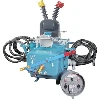
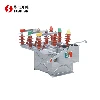
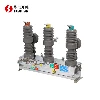
In power switchgear (such as vacuum circuit breakers), sealed poles and ordinary insulation cylinders are two common insulation structure designs, which have significant differences in technical principles, performance characteristics and application scenarios. The following is a comparative analysis of the two:

1. Solid-Insulated Pole
Structure and Process
Packaging technology: The core components such as vacuum arc chamber and conductive circuit are integrally coated by epoxy resin (or silicone rubber) casting process to form an integrated insulation module.
Material: Epoxy resin (commonly used APG process, i.e. automatic pressure gel molding), with high mechanical strength, weather resistance and electrical performance.
Typical design: There is no air gap between the arc chamber and the insulation layer, and no additional insulation tube is usually required on the outside.
Core advantages
High insulation reliability:
No internal air gaps or interfaces to avoid partial discharge (high PDIV value).
Dust-proof, moisture-proof, and dirt-proof (suitable for high humidity and high dirt environments).
Mechanical strength:
Good seismic performance, suitable for frequent operation or vibration scenarios (such as rail transit).
The overall structure is compact, and the volume is 30%~50% smaller than traditional designs.
Maintenance-free:
Epoxy resin has a long aging period (usually >30 years), and there is no need to regularly clean or check the internal insulation.
Application scenarios
Medium and high voltage fields: 12kV~40.5kV vacuum circuit breakers (such as VS1, VD4 and other models).
Harsh environments: corrosive environments such as mines, chemicals, and coastal areas.
Compact switchgear: mid-mounted switchgear such as KYN28A-12.
Limitations
High cost: The casting process is complicated, the mold cost is high, and small batch production is not economical.
Difficult heat dissipation design: Epoxy resin has poor thermal conductivity, and the heat dissipation structure needs to be optimized (such as built-in heat sink).
Unrepairable: Internal failure requires the entire pole to be replaced.
2. Porcelain/Composite Insulation Cylinder
Structure and process
Split design: The vacuum interrupter is equipped with a ceramic or epoxy fiberglass tube as external insulation, which is mechanically fixed to the interrupter but not integrated.
Material:
Ceramic insulation tube: traditional material, resistant to high temperature but easy to crack.
Composite insulation tube: epoxy resin + fiberglass (lightweight, impact resistant).
Core Features
Economical:
Low manufacturing cost, suitable for price-sensitive projects.
The arc extinguishing chamber can be replaced separately, and the maintenance cost is low.
Good heat dissipation:
Air circulation or direct heat dissipation of metal parts, better temperature rise control.
Flexibility:
The insulation cylinder and arc extinguishing chamber can be flexibly matched to adapt to different types of circuit breakers.
Application scenarios
Traditional switchgear: such as ZW32 outdoor pole-mounted circuit breakers.
Low-voltage or medium-voltage popular products: scenarios below 12kV or with less stringent insulation requirements.
Temporary power supply equipment: occasions where the arc extinguishing chamber needs to be replaced quickly.
Limitations
Limited insulation performance:
The presence of air gaps or interfaces can easily cause surface discharge due to moisture and dirt.
Requires regular cleaning (such as when the creepage distance is insufficient).
Low mechanical strength:
Ceramic tubes are fragile, and composite tubes may delaminate after long-term aging.
Large volume: Additional space is required to meet insulation distance requirements.
3.summary
| Comparison item | Solid sealed pole | Ordinary insulation tube |
|---|---|---|
| Insulation performance | No air gap, partial discharge resistance, high reliability | Depends on air gap and interface, easily affected by environment |
| Mechanical strength | Seismic and shock resistant, integrated structure | Ceramics are fragile, composite materials need to be protected against aging |
| Volume/weight | Compact and lightweight (low density of epoxy resin) | Large (especially ceramic tubes) |
| Heat dissipation capacity | Poor, auxiliary heat dissipation needs to be designed | Better, air circulation and heat dissipation |
| Cost | High (complex process) | Low (simple materials and manufacturing) |
| Maintenance | Cannot be disassembled, replaced as a whole | Arc extinguishing chambers can be replaced separately |
| Typical applications | High-end switch cabinet, harsh environment | Traditional circuit breakers, economical equipment |
4.Selection suggestions
Prioritize sealed poles:
High humidity and high pollution (such as coastal areas and chemical industrial areas).
Switch cabinets with frequent operations or limited space (such as data centers).
Select insulation cylinders:
Limited budget and dry and clean environment.
If you need to know more about the technical details, product selection or business cooperation of vacuum interrupter, sealed pole or related power equipment, please feel free to contact us:pannie@hdswitchgear.com. we will wholeheartedly provide you with professional services!