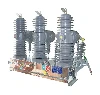
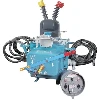
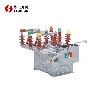
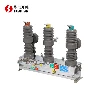
In the switchgear cabinet, the operating mechanism is the core component for controlling circuit breaker breaking, closing and maintaining the state, and its working process involves mechanical transmission, electrical control and energy transfer. The following is the detailed workflow and key links of the operating mechanism in the switchgear cabinet:

1. Basic workflow of operating mechanism
(1) Closing operation
Step 1: Energy storage
Spring mechanism: motor or manual compression spring energy storage (mechanical locking fixed after the completion of energy storage).
Electromagnetic/hydraulic/pneumatic mechanism: Energy is stored by power supply or gas/liquid pressure system.
Step 2: Release energy
After receiving the closing signal (manual button or relay protection command), release the stored energy (e.g. spring release, electromagnet energisation, hydraulic valve opening).
Step 3: Actuating the circuit breaker
The energy drives the circuit breaker's movable and static contacts to close through mechanical transmission components such as connecting rods and gears.
Step 4: Maintaining Closure
A mechanical latch or pressure system maintains the closing state and ensures stable contact.
(2) Breaking operation
Trigger signals: manual tripping button, relay protection action (e.g. short circuit fault), remote control signal.
Energy release:
Spring mechanism: the release of the parting spring, quickly pull open the contacts.
Electromagnetic/hydraulic/pneumatic mechanism: Driving the tripping by electromagnetic force or pressure difference.
Arc extinguishing process: When the contacts are separated, the arc extinguishing chamber (e.g. vacuum, SF6) extinguishes the arc and cuts off the current.
2. Cooperative work of operating mechanism and switchgear cabinet
(1) Electrical control circuit
Closing circuit:
Press the closing button → control relay is energised → power supply of energy storage motor or solenoid is switched on → the mechanism is operated.
Breaking circuit:
Protective relay detects the fault → sends out the tripping signal → tripping coil is energised → triggers the mechanism to release.
Interlocking protection:
Anti-misoperation: Ensure that the circuit breaker can be operated only when the earth switch is tripped and the cabinet door is closed.
Status indication: Feedback the status of 'closing/breaking' to signal lamp or monitoring system through auxiliary contact.
(2) Mechanical transmission system
Linkage: Transmit the linear or rotary motion of the operating mechanism to the contact system of the circuit breaker.
Buffer device: Absorb the mechanical shock during the opening and closing process to prevent the contacts from bouncing.
(3) Energy management
Spring mechanism: The energy storage motor automatically recompresses the spring after closing the circuit breaker to prepare for the next operation.
Hydraulic/pneumatic mechanism: Maintains the rated pressure by means of a compressor or a pump to ensure readiness for operation.
3. Examples of typical operating mechanisms in switchgear cabinets
Case 1: Spring mechanism (vacuum switchgear type VS1)
Closing: Pressing the closing button → motor compresses the spring → release when energy storage is complete → contact closes.
Opening: protection action → opening coil is energised → latch is released → spring quickly opens.
Case 2: Electromagnetic mechanism (conventional medium-voltage switchgear)
Closing: DC power supply energised → electromagnet attracted → driving linkage closes.
Splitting: Splitting coil is energised → release mechanism is activated → contact is separated.
Case 3: hydraulic mechanism (GIS high-voltage switchgear)
Closing: hydraulic pump builds up pressure → cylinder pushes piston → contact closes.
Splitting: solenoid valve opens → high pressure oil releases → piston reverses motion and splits.
4. Critical Considerations
Reliability of operation power supply:
The spring mechanism needs to ensure that the power supply of the energy storage motor is normal, and the solenoid mechanism needs a stable DC power supply (e.g. battery).
Mechanical maintenance:
Regularly lubricate the connecting rod and check the wear of the latch to prevent jamming or wrong disengagement.
Interlock function verification:
Test the interlocking function of 'five-proof' (e.g. preventing the disconnecting switch from opening and closing with load).
Environmental adaptability:
Under low temperature environment, the hydraulic mechanism should prevent the oil from solidifying, and the pneumatic mechanism should prevent the condensate from freezing.
5.Conclusion
The operating mechanism in the switchgear cabinet realises the reliable opening and closing of the circuit breaker through the closed-loop process of 'energy storage-release-transmission', and its performance has a direct impact on the fault removal capability and safety of the switchgear cabinet. Its performance has a direct impact on the fault removal capability and safety of the switchgear. In actual operation, it is necessary to carry out comprehensive maintenance in combination with the electrical control, mechanical transmission and energy system to ensure fast response and long service life.For more information,please send us:pannie@hdswitchgear.com.