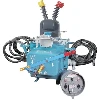
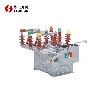
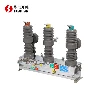
The operating mechanism of high-voltage circuit breaker is the core component to control its breaking, closing and maintaining a stable state, the common types and their roles are as follows:

1. Spring Operating Mechanism
Role: the use of pre-compressed spring energy storage, release energy to drive the circuit breaker action.
Features:
Breaking/closing: energy is stored in the spring by motor or manually, and the energy is released quickly when breaking, so the action is reliable.
No external energy required: can be operated independently after energy storage, suitable for occasions without continuous power supply.
Application: Medium and high voltage circuit breakers (e.g. 10kV~35kV), commonly used in vacuum circuit breakers or SF6 circuit breakers.
2. Electromagnetic Operating Mechanism (EOM)
Role: To generate magnetic force to drive the action of circuit breaker by energising the electromagnet.
Characteristics:
Fast response: directly using the current to generate power, fast action speed.
Dependent on the power supply: the need for large-capacity DC power supply (such as batteries), high instantaneous current requirements.
Application: Traditional oil circuit breaker or a small part of SF6 circuit breaker, gradually replaced by spring mechanism.
3. Hydraulic Operating Mechanism (Hydraulic Operating Mechanism)
Role: Using the pressure of hydraulic oil to store energy, through the cylinder piston to drive the circuit breaker.
Characteristics:
High power output: suitable for ultra-high voltage (e.g. 500kV or above), large-capacity circuit breakers.
Complex maintenance: regular inspection of the hydraulic system is required and there is a risk of leakage.
Application: SF6 circuit breakers in UHV substations or GIS.
4. Pneumatic Operating Mechanism (Pneumatic Operating Mechanism)
Role: Use the pressure of compressed air (or SF6 gas) to drive the circuit breaker action.
Features:
High-speed action: fast release of air pressure, short time of breaking (e.g. ≤20ms).
Required air source system: rely on air compressor and gas storage tank, high maintenance cost.
Application: high frequency operation or some high voltage SF6 circuit breakers.
5. Motor-Driven Mechanism
Function: Directly drive the gears or connecting rods through the electric motor to complete the operation.
Characteristics:
Slow but precise: slow closing speed, mostly used for disconnecting switches or low voltage circuit breakers.
Continuous power supply requirement: stable AC power supply is required.
Application: Some medium-voltage circuit breakers or scenarios with low automation requirements.
6.Core functions of the operating mechanism
Breaking and closing: quickly and reliably cut off or connect the circuit.
Holding state: Ensure that the circuit breaker is stably locked in the breaking or closing position to prevent false operation.
Energy reserve: Some mechanisms (e.g. spring, hydraulic) can store energy to achieve passive operation.
Interlocking and protection: cooperate with relay protection to achieve rapid fault removal.
7.Selection Considerations
Voltage level: High/ultra-high voltage requires more driving force (e.g. hydraulic).
Frequency of operation: spring or pneumatic mechanisms are preferred for frequent operation.
Power conditions: spring mechanism is preferred when there is no continuous power supply.
Environmental Requirements: Hydraulic mechanisms should be used with caution in low temperature environments (changes in oil viscosity).
Different mechanisms have their own advantages and disadvantages, the actual application needs to be based on the type of circuit breaker, system requirements and cost of a comprehensive choice.If you have order or any questions,please contact at:pannie@hdswitchgear.com.