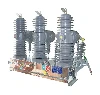
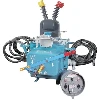
High-voltage switchgear is a critical piece of equipment in the power system, and its insulation performance directly affects the safe and stable operation of the power grid. Common insulation fault types, causes, and consequences are as follows:

Short circuit
Small animals such as snakes and rats can enter the switchgear through holes in the cable trench, causing bridging between busbars or busbars inside the switchgear and resulting in phase-to-phase or single-phase-to-ground short circuits. This can cause the switchgear to trip and lose power, affecting the safe operation of the power grid.
Moisture and Surface Contamination of Insulating Components
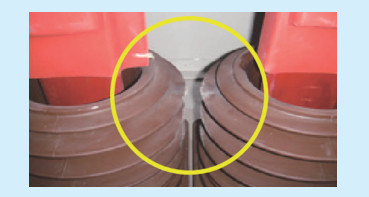
The switchgear contains many insulating components made of epoxy resin (such as bushings, transformers, post insulators, etc.). Because the equipment itself is not completely sealed, its moisture and contamination resistance is poor. Furthermore, epoxy resin is prone to absorbing water. In rainy weather with high humidity, moisture on the surface of the insulating components can penetrate rapidly into the interior of the components under the influence of an electric field, leading to a significant decrease in insulation resistance and an increase in surface leakage current, potentially causing corona or arc discharge , as shown in Figure 1, where phase-to-phase discharge occurs between the insulating components.
Insufficient Electrical Safety Distances
Statistical analysis of switchgear insulation maintenance cases revealed a common problem: insufficient phase spacing. Taking the KYN61 series 35 kV switchgear as an example, measurements showed the distance between the three-phase moving contacts was 250 mm, and the maximum distance between the three-phase leads was 295 mm. The air clearance between phases and between phases and ground was insufficient, failing to meet the requirement of at least 300 mm for indoor power distribution clearance as stipulated in the "Eighteen Major Accident Prevention Measures of the State Grid Corporation of China".
High-voltage equipment discharges through insulating baffles
To reduce switchgear size and production costs, manufacturers typically add an epoxy resin or SMC insulating baffle between phases to alter the electric field distribution and improve interphase insulation. However, this does not fundamentally improve the switchgear's insulation structure. High humidity levels inside the switchgear lead to dust and moisture accumulation. Combined with the moisture-absorbing properties of the epoxy resin or SMC insulating baffle, under long-term power frequency voltage, this increases the likelihood of discharge, accelerating the deterioration of surrounding insulation materials. This insulation deterioration further distorts the surrounding electric field distribution, creating a vicious cycle that gradually forms conductive channels, ultimately leading to an accident.
Circuit breaker contact discharge
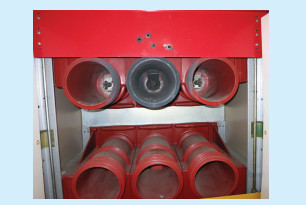
Circuit breaker moving and stationary contact discharge is mainly caused by poor contact between the moving and stationary contacts. Contact wear, displacement, corrosion, rust, or insufficient insertion of the moving contact can severely affect the conductivity of the contacts. Excessive contact resistance can cause the contacts to heat up, and even cause the switch cabinet to burn and explode . Figure 2 shows the discharge phenomenon on the surface of the handcart contact box.
Busbar to Bushing Discharge
Old switchgear uses bushings without shielding design, resulting in gaps between the busbar and the bushing. The bushing and busbar are not at the same potential. After the switchgear has been in operation for a period of time, the bushing (epoxy resin) absorbs moisture, reducing its insulation performance. This leads to partial discharge at small gaps (as shown in Figure 3), seriously affecting the safe operation of the power grid.
Poor installation and construction techniques
Irrational arrangement of components inside the switchgear and non-compliance with installation specifications are also important factors causing switchgear accidents, mainly manifested in the following aspects:
(1) Although the busbars and components inside the cabinet have been chamfered, there are still sharp edges and burrs, which can easily form a highly uneven electric field, thus causing point discharge;
(2) The bolts at the busbar connection are too long;
(3) The insulating rods fixing the insulating baffles are not installed according to specifications and are too close to the busbars, causing discharge.
Prevention and Detection Measures
Strengthen Insulation Design
Select all-condition insulation materials (such as anti-flashover coatings).
Optimize electric field distribution and employ shielding technology.
Environmental Control
Install heaters, fans, or dehumidifiers.
Seale the enclosure to prevent small animals from entering.
Regular Inspection and Maintenance
Partial Discharge Detection: Ultrasonic and UHF online monitoring.
Insulation Resistance Testing: Regularly measure the resistance of the main circuit and insulation components.
Infrared Thermometry: Detect overheating insulation defects.
Cleaning and Tightening: Remove dirt and check for loose bolts.
Overvoltage Protection
Install surge arresters and overvoltage absorption devices.
Summary
Insulation faults in high-voltage switchgear are often caused by the coupling of multiple factors related to electricity, heat, and environment. Prevention is better than cure. It is recommended to focus on the three core risk points of partial discharge, humidity, and pollution through online monitoring combined with regular maintenance, and to strictly control equipment selection, installation processes, and environmental management. For older equipment, insulation upgrades or replacements can be carried out gradually to improve overall reliability.
Shaanxi Huadian uses high-strength, arc-resistant, and creepage-resistant special epoxy resin and composite insulation materials, with insulation performance far exceeding national standards. Stringent manufacturing processes and environmental adaptability mean that choosing Shaanxi Huadian means choosing not just a switchgear, but a comprehensive insulation health management solution covering the entire equipment lifecycle. For inquiries, please contact us:pannie@hdswitchgear.com.