Cleaning Switchgear
The main contaminants in the switchgear include dust and moisture on the surface of insulation components, dust and verdigris on the surface of busbars and busbars, and dust and oil stains on the surface of the switchgear cabinet. First, use sandpaper to polish the edges and burrs of the conductors. Then, use RS-10 surface treatment agent to remove the contaminants inside the cabinet. Finally, use a clean surface treatment agent to thoroughly clean it again.
Busbar Insulation Treatment
Early, busbars in switchgear were insulated with heat-shrink tubing, which tended to age and crack after a period of operation. Due to the inability to adequately insulate irregularly shaped components within the cabinet, discharge often occurred at these points. Furthermore, the lack of hydrophobicity in heat-shrink tubing made it prone to surface discharge and creepage in humid environments. Some foreign switchgear manufacturers have attempted to use fluidized bed spraying of flame-retardant insulating powder in the factory, but this method is not suitable for already installed switchgear. Based on years of construction experience, after removing contaminants from the busbar surface with a surface treatment agent, 50 mm × 0.5 mm (width × thickness) silicone rubber self-adhesive tape can be wrapped around the exposed busbar (as shown in the figure) for insulation treatment. This method is convenient and quick to implement. It is recommended to wrap two layers of tape around exposed busbars in switchgear with voltage levels of 10 kV and below, and five to six layers of tape around exposed busbars in 35 kV switchgear.
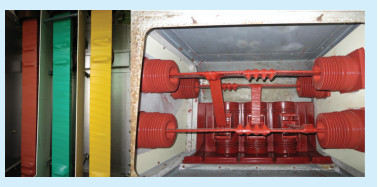
Silicone rubber self-adhesive tape treatment effect on busbars
Gap Sealing
Gap exists between the branch busbar end and the inner wall of the contact box at the point where the busbar enters the center-mounted contact box and at the stationary contact of the switchgear bushing. After the switchgear has been in operation for a period of time, discharge can easily occur in these areas. Using RS-45 silicone sealant to seal these gaps can effectively solve the problem of discharge between gaps (as shown in the figure).

Use RS-45 to seal the gap between the busbar and the bushing.
Handcart Insulation Treatment
The insulation components of the handcart are coated with SRTV anti-flashover paint. The surface of the stationary contact insulation box is treated with SRTV anti-flashover paint and RS-45 silicone sealant (see figure) to prevent the insulation surface from getting damp and forming a water film discharge.
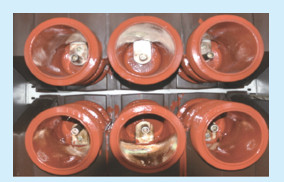
Static contact box treated with SRTV and RS-45
Cable Compartment Treatment in Switchgear
Most of the moisture inside the switchgear enters through the cable compartment, making its sealing crucial. RS-45 silicone sealant is used to treat cable inlets and outlets, providing excellent sealing (as shown in the figure). The silicone sealant is non-curing and crack-resistant, compensating for the shortcomings of fireproof putty.

The effect of using RS-45 to seal cable gaps
Overall Moisture-proof Treatment of Switchgear
To ensure the overall insulation and moisture-proof effect of the switchgear, the interior of the switchgear is sprayed with transparent SRTV anti-flashover coating, including all insulating components, insulating baffles, busbars covered with self-adhesive tape, and the inner walls of the switchgear, to prevent adverse effects on the safe operation of the switchgear due to limited space or inadequate insulation treatment at corners.
Conclusion
The reliability of switchgear plays a crucial role in the safe and stable operation of the power grid. Operational experience shows that switchgear accidents caused by insulation problems account for a relatively high proportion and have serious consequences. The switchgear treated with the above insulation scheme has demonstrated stable operation in actual operation, with no similar insulation faults occurring since. This can serve as a reference for other companies facing similar problems.
Traditional switchgear often faces challenges such as accelerated aging of insulation components, condensation flashover, pollution flashover, and concealed partial discharge. We understand that insulation issues are not merely superficial but involve a deep interplay of systems engineering principles. Shaanxi Huadian, specializing in high-voltage switchgear, uses its core technology of "insulation as the foundation and reliability as the soul" to build an unbreakable power safety barrier for you. For inquiries, please contact us.
Email:pannie@hdswitchgear.com.
Whatsapp/Wechat:+8618789455087