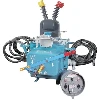
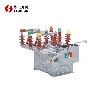
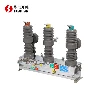
Simply put, the grounding knife in a high-voltage switchgear is designed to protect personnel. When you close the grounding knife and begin maintenance, if a sudden power outage occurs, the current is directly directed to the ground, forcing a short circuit and causing the circuit breaker to trip. This reduces the risk of electric shock. The human body's resistance is greater than the grounding resistance, and this principle is used to divide the current by a greater resistance, thereby significantly reducing the current flowing from the human body to the ground.

The grounding knife is a crucial safety component in high-voltage switchgear. Its primary function can be summarized as follows: After a high-voltage line is powered off, it reliably grounds the line, preventing accidental power supply, dissipating residual charge, and preventing induced voltage on the line, thus creating a safe working environment for maintenance personnel.
The following is a detailed breakdown of its specific functions:
1. Ensuring Personal Safety (Most Important Function)
This is the most fundamental and crucial function of a grounding knife. When inspecting or maintaining lines or equipment (such as transformers, circuit breakers, or cables), the circuit breaker must be disconnected and isolated before closing the grounding knife.
Preventing Misoperation or Accidental Power Supply: During maintenance, if someone mistakenly closes a circuit breaker or if power is accidentally supplied from a higher-level power source, a significant current can flow directly through the grounded grounding knife, causing a short circuit and triggering the relay protection device to trip and cut off power. Without a grounding knife, this current would flow directly through the maintenance personnel, potentially causing fatal electric shock.
"Visible" Safety Measures: Grounding knives typically have a mechanical lockout, and their open and closed states are clearly visible (via a viewing window). This provides workers with a clear, visible signal confirming that the equipment is securely grounded.
2. Discharge Residual Charge and Induced Current
Even after power is removed, high-voltage cables and electrical equipment can still store significant amounts of static charge. Furthermore, other live lines running parallel to or crossing the de-energized line can generate dangerous induced voltages on the de-energized line through electromagnetic induction.
Ground Discharge: When the grounding switch is engaged, this residual charge and induced current are discharged directly to ground, quickly reducing the line potential to zero (ground potential), effectively protecting maintenance personnel from electric shock.
3. Replacement of Safety Ground Wires
Maintaining maintenance with the grounding switch engaged can replace the need to hang a temporary grounding wire. While some strict regulations may still require a temporary grounding wire, a qualified grounding switch provides an equally reliable and more convenient fixed grounding point, reducing the number of steps and operational risks.
4. Functioning with Disconnectors to Implement Logical Operation Interlocks
High-voltage switchgear is designed to adhere to a strict operating sequence, commonly known as the "Five Preventions." The grounding switch is a key component in achieving these "Five Preventions":
Preventing Live Closing of the Grounding Switch: When the circuit breaker is in the closed (energized) position, the grounding switch is mechanically or electrically locked out, preventing it from being closed.
Preventing Closing with the Grounding Switch: Circuit breakers and other disconnectors can only be closed and energized when the grounding switch is in the open (disconnected) position. If the grounding switch is engaged, the circuit breaker is locked out and cannot be closed.
This mandatory logical relationship physically eliminates incorrect operating sequences, ensuring operational safety.
Example Work Scenario:
Suppose you need to inspect the cables behind a distribution cabinet.
Power Outage: First, disconnect the circuit breaker.
Isolation: Open the disconnector on the line side, creating a clear disconnect point and completely isolating the inspection line from live parts.
Electrical Testing: Use a tester to confirm that the line is voltage-free.
Grounding: Close the grounding switch. This short-circuits the three-phase conductors of the line and reliably grounds them.
Maintenance: Workers can safely perform maintenance work. Even if someone accidentally restores power at this point, a short circuit will immediately trip the circuit breaker, protecting personnel.
Power Restoration: After maintenance is complete, the grounding switch must be opened first, followed by the disconnector, and finally the circuit breaker. This sequence is strictly enforced by a locking device and cannot be reversed.
Which high-voltage switchgear requires a grounding knife? Which does not?
Generally speaking, feeder cabinets, where voltage may be returned from an external source, require a grounding knife. Auxiliary cabinets such as station transformers, voltage transformers, and sectionalizers generally do not require a grounding knife. When installing a grounding knife in a high-voltage cabinet, it must be assembled according to the "five protections" requirements to prevent accidental operation.
Note: Grounding knives are generally installed in high-configuration high-voltage cabinets and are not required in standard low-voltage cabinets.
Summary
| Function | Explanation |
|---|---|
| Safety protection | Provides life safety for maintenance personnel, preventing electric shock. |
| Charge discharge | Discharges static electricity and induced voltage from the line. |
| Forced locking | As the core of the "Five-Protection" system, it prevents misoperation. |
| Ground replacement | Provides a reliable, fixed grounding point, simplifying operation. |
Therefore, the grounding knife is an indispensable safety guard in the high-voltage switchgear. It is absolutely forbidden to operate the grounding knife when it is energized, and its operation must strictly comply with safety regulations.
Contact Us
If you are interested in High Voltage Grounding Switch and want to learn more about grounding knife.please contact ShaanXi Huadian! We will provide you with professional product selection, technical support and quality service.
📞:+8618789455087
📧 :pannie@hdswitchgear.com