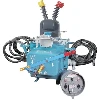
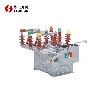
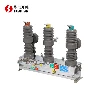
A high-voltage vacuum contactor is a switching device that uses a vacuum interrupter to connect and disconnect circuits, making it particularly suitable for frequent operation in high-voltage systems. It mainly consists of a vacuum interrupter and an operating mechanism. The vacuum interrupter serves two purposes: reliably extinguishing arcs when carrying normal operating current and when frequently interrupting operating current. However, it cannot interrupt overload current or short-circuit current. The operating mechanism consists of a holding coil with an iron core and an armature. When the coil is energized, it attracts the armature, closing the contactor; when the coil is de-energized, the contactor opens. Holding coils are generally available in both DC and AC versions.

How does it work?
Its working principle mainly includes the following parts:
Core arc-extinguishing technology: Its core component is the vacuum switch tube (vacuum interrupter). The high vacuum inside the tube has extremely high insulation strength. When the contacts separate, the generated arc rapidly spreads to the tube wall, and the metal vapor condenses rapidly when the current crosses zero, thus extinguishing the arc within milliseconds and preventing reignition.
Operating mechanism drive: Driven by an electromagnetic system or permanent magnet mechanism. When the coil is energized, the armature drives the contacts to close; when the coil is de-energized, the opening spring separates the contacts. High-performance contactors use dual coils (starting and holding) or permanent magnet mechanisms to reduce energy consumption and noise.
Typical structure: Usually, a vertical structure is used, integrating the vacuum interrupter, insulating components, and operating mechanism into a single unit, facilitating maintenance and assembly into an F-C circuit complete set of equipment.
Where is it mainly used?
Due to its ability to withstand frequent operation, high-voltage vacuum contactors are widely used in the following scenarios:
Controlling high-voltage motors: Particularly suitable for applications requiring frequent starts and stops, such as various motors in the metallurgical, mining, and petrochemical industries.
Switching transformers and capacitors: Used to control the switching of electric furnace transformers and reactive power compensation capacitor banks.
Forming an F-C circuit: Often combined with a high-voltage current-limiting fuse (i.e., an F-C circuit), where the contactor handles frequent operation and the fuse provides short-circuit protection, used in power plants, industrial enterprises, and other similar locations.
Main Common Fault Causes
1. Failure to Store Energy: Failure to store energy is one of the most common faults in vacuum contactors, especially in ratchet- and pawl-driven energy storage mechanisms, where the failure probability is relatively high. The energy storage mechanism's operation depends mainly on three components: the energy storage motor, the drive mechanism, and the positioning element. Focusing on these three components makes it easy to pinpoint the root cause of the fault.
2. No Closing Action: Failure to close properly is mainly related to whether the closing electromagnet is engaged, whether energy storage is complete, and whether the positioning element is functioning correctly.
3. Inability to Close (Closing Without Engaging): A closing action that fails to actually close the circuit is called an inability to close the circuit without engaging. When analyzing this type of fault, start by examining the closing holding mechanism (locking), and then analyze whether it is related to the energy storage section.
4. Failure to Open: It is important to emphasize that when a contactor fails to operate or engages in an inability to open, before analyzing and repairing the contactor itself, it is crucial to determine whether the cause lies in the control and secondary components, such as auxiliary switches or terminal blocks, before proceeding with the contactor's analysis and diagnosis.
Key maintenance points: Routine maintenance should focus on contact wear (the cumulative allowable wear thickness is typically 3mm). In some overvoltage-sensitive locations, it may be necessary to install an RC circuit (R-C circuit) or a metal oxide surge arrester for overvoltage protection.
Contact Us
High-voltage vacuum contactors, with their long lifespan and high reliability, are indispensable components in modern high-voltage power distribution and control systems.
As an early participant in the research and development of mainstream permanent magnet vacuum circuit breakers in China, Shaanxi Huadian Electric Co., Ltd. has incorporated its accumulated expertise in vacuum arc extinguishing technology and intelligent control concepts into its full range of high-voltage vacuum contactor products. We not only manufacture components but also inherit the core technologies of a generation of circuit breakers. From VS1 vacuum circuit breakers to high-voltage contactors, Shaanxi Huadian provides you with a full range of products to support your high, medium, and high-voltage power distribution systems. Shared technology, shared service! Contact us:pannie@hdswitchgear.com.