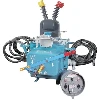
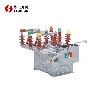
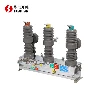
Vacuum contactors, vacuum circuit breakers and vacuum interrupters all belong to the vacuum switching appliances, the core of the use of vacuum interrupters (vacuum tubes) as an arc extinguishing medium, but the three in the design, function and application of significant differences. The following are their differences, connections and typical applications:
 |
 |
 |
Vacuum Interrupter
Definition:
Vacuum interrupter is the core component of vacuum switching appliances, consisting of sealed ceramic or glass shell, movable and static contacts, shielding and bellows, the internal high-vacuum environment (≤ 10-⁴ Pa), the use of vacuum high dielectric strength and diffusion arc extinguishing ability to cut off the current.
Function:
Responsible for quickly extinguishing the arc when the current passes through zero to achieve circuit breaking.
Features:
No oil, no SF₆, environmental protection;
Long life (mechanical life of tens of thousands of times, electrical life of thousands of times);
Breaking capacity depends on contact material and structure design.
Applications:
Embedded as a core component in vacuum contactors, vacuum circuit breakers and other equipment, not used separately.
Vacuum Contactor
Definition:
A frequently operated low-voltage or medium-voltage (usually ≤ 7.2kV) switchgear with a vacuum interrupter as the core, to be protected by fuses or relays.
Function:
Frequent switching on/off of normal load currents (e.g. motors, transformers);
Cannot switch on/off short-circuit currents (dependent on external protective devices).
Features:
High operating frequency (up to hundreds of times per hour);
Long mechanical life (million cycles class);
Small size for compact installation.
Typical applications:
Motor control (e.g. mining, metallurgical equipment);
Capacitor bank switching;
Industrial applications requiring frequent operation.
Vacuum Circuit Breaker (VCB)
Definition:
Medium and high voltage (usually 7.2kV~40.5kV) protection appliance with integrated vacuum interrupter and independent protection mechanism (e.g. spring-operated mechanism, striker).
Function:
Breaks normal current and short-circuit fault current (no external protection required);
Equipped with short-circuit protection and overload protection;
Remote automatic control is possible.
Features:
High breaking capacity (up to tens of kA);
Short operating life (thousands of times);
Complex structure and high cost.
Typical applications:
Substation, distribution system protection;
Power plants, industrial and mining enterprises main distribution circuit;
Occasions requiring high reliability protection.
Links and differences between the three
| characterisation | Vacuum Interrupters | Vacuum contactor | Vacuum Circuit Breaker |
|---|---|---|---|
| Intrinsic | Core components | Complete equipment (including interrupter) | Complete equipment (including interrupter + protection) |
| Breaking capacity | Dependent on external design | Load current only | Load current + short circuit current |
| Protection function | No | External fuse/relay required | Built-in release mechanism |
| Operating frequency | - | Very high (frequent operation) | Lower (protection purpose) |
| Typical Voltage | General Purpose | ≤7.2kV | 7.2kV~40.5kV |
contact us
We are committed to providing our customers with:
◆ Cost-effective vacuum interrupters and complete equipment;
◆Rapid response technical support and after-sales service;
◆ Customised solutions to suit special voltage and current requirements.
:www.hdswitchgear.com
:+8618789455087